Let’s talk today about an advanced post concussion syndrome rehabilitation approach. This is what we call a reading VOR. And so this is a little bit more confusing for a lot of people if you haven’t done a lot of our basic information or basic courses on the vestibular system, but whenever we’re dealing with someone that’s had a traumatic brain injury, and remember we’re talking about this because this month is traumatic brain injury awareness month.
We want to make sure that you have. ideas about the basics which we’ve talked about in terms of building an aerobic base doing air hunger work with our Post concussion clients, but now we’re talking about all right, I have someone maybe it’s an athlete. They had a concussion, their rehab is going great, but I need to know how to make things harder for them so that we continually improve their visual system, their vestibular system, their movement, to get them back to like a high performance level.
So I want to show you today, this kind of advanced version of a vestibular training drill. Now the vestibular systems, your inner ear, we have tons of blogs on this. We have a free mini course. You can go watch all of that stuff. But put very basically, your inner ear is what keeps you upright, tells your brain which direction you’re going, which way is up.
It is the foundation on which all human movement is built, your eyes and your inner ear. So if it is even marginally messed up, it will impact you in terms of pain, in terms of strength, in terms of flexibility. And what we see after concussion is that the vestibular system is one of the most consistently problematic areas.
And it is also in our, from our perspective, one of the areas that is, often overlooked, never rehabbed or poorly rehabbed. So to rehabilitate the vestibular system, we have to go through a whole series of different exercises and training. But one of the basics is called the vestibulo-ocular reflex, the VOR.
Basically what that means is I have to look at something, keep my eyes focused on it while my head is in motion. And we have a lot of different movements that the head and neck can do. We can rotate. We can flex up and down. We can do diagonals. We can do lateral bending. We can go forward and back, etc.
All of those different movements impact the vestibular system differently, uh, based off the angle of the head movement. And there is this very close connection between the vestibular system and the eyes. So what should happen is regardless of the speed of my movement, my eyes should be able to maintain clarity in the fixation point.
This is one of the big tests that we do. If you go to your eye doctor and they have you look at the chart, the 20 20 chart, it’s got the big letter at the top, and you work your way down. One way to quickly diagnose in the medical world a vestibular problem, or a vestibulo-ocular reflex problem, is to have someone read down the chart, and let’s say they can read the 20 20, and we say, okay, look at that letter A on the 20 20, and now turn your head back and forth relatively quickly, and they go, whoa, it’s getting really blurry.
If they go up by two lines to get back to clarity, that’s a diagnosable vestibular deficit right there. So we know there’s this huge linkage between the inner ear and your ability to see clearly while your head is in motion. Well, guess what has to happen in sport in real world? Function. We have to have clear vision while we’re moving, while our head’s turning.
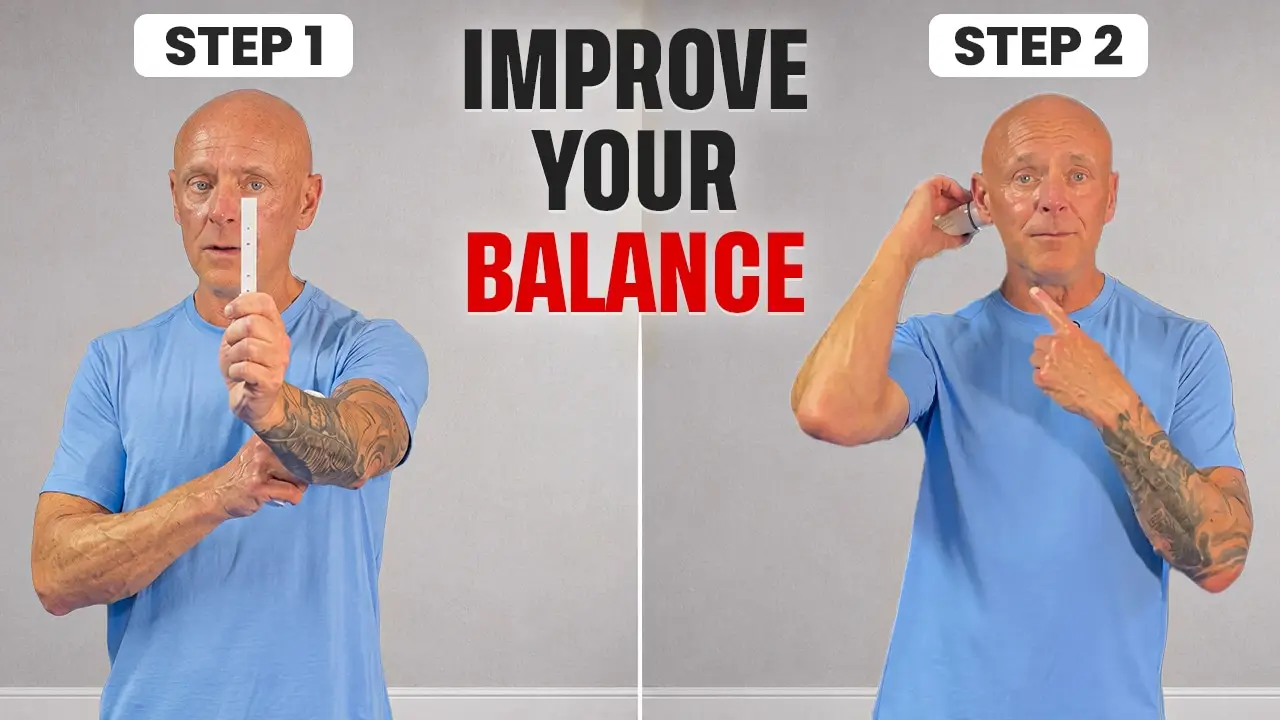
So an advanced rehabilitation approach is to do that on purpose. All that you need for this is something to read. All right. So iPhone here, open it up, put on your Kindle, whatever it is that you’re going to read your newsfeed. I don’t care. What I like to make sure of is that if you hold it up, at, your normal reading distance, that the letters are clear.
Now, for some of us, that might be out here. For some of us, that might be here. If you have to hold on, or use your glasses in the beginning, that’s okay. Because we want a very clear visual picture. Once you have a clear visual picture of one letter, Your job is going to be very simple. You’re going to begin reading, like you would, but I want you to do it out loud.
This is going to be more challenging, because not only do you have to coordinate your head and eyes, you’re also going to have to vocalize, which involves more of the brain. So you will begin doing a rotational movement. Now, it doesn’t have to be huge, it’s going to be a small rotation back and forth. You want to be moving in a relatively good clip, but the way that you’ll understand if you’re doing well with this, is you’ll be able to monitor the speed.
And if you can go basically at any speed that you want while maintaining clarity, while maintaining the ability to read out loud, you know that all your systems are starting to work really well together. So, you would set your timer, and it would be 30 seconds of reading while the head is rotating right and left.
30 seconds of reading while the head is nodding up and down. 30 more seconds of reading while the nose is going up and right, down and left. And then 30 more with the head, the nose going up and left, down and right. And then 30 more with your head tilting back and forth. And then finally, another 30 seconds with the head moving forward and back.
If you are able to maintain clarity and keep reading smoothly down the page, as you’re doing all those different movements, again, that’s a great indication that your eyes, your inner ear are working really well together. We should be able to keep advancing that then by increasing the speed of the head movement by asking you to read faster or by adding movement to it.
A lot of our athletes eventually, as just a basic simple rehab drill that I’ll have them do for three or four minutes at home, is they open up their book, they open up their Kindle or whatever, they start and they walk forward as they’re reading, they walk backwards as they’re reading, as they’re going through the different head movements.
This is a very challenging, believe it or not, integrated drill. And if you are able and capable of doing this, it speaks volumes about the overall health of your brain, your brainstem and these important systems. What you will see with most of your concussion clients is as they begin trying to read, not just stare at a point, all of a sudden they will have to slow down.
You will as a coach be able to film that. And you will have an immediate objective finding in terms of how fast they’re moving so that you can progress them over time. You will also notice probably some really big differences in one of the angles of the head movement. So this is an advanced visual and vestibular rehabilitation drill.
I love using it in the overall post concussion rehabilitation process. I hope you get a ton of value from it. If you’re new to Z Health, obviously we’re a brain-based education company. We do a lot of cool stuff with the eyes, the inner ear. We work with doctors, coaches, and therapists from all over the world, showing them how to integrate cutting edge neuroscience in the stuff that they’re already awesome at.
We deal with pain, we deal with performance and everything in between. So if that is of interest to you, subscribe to the channel, sign up for our free mini course, talk to us, ask us questions because we actually really love helping professionals get better because I think all of our clients deserve the very best care that we can give them.
All right, take care.
Want to learn more? Check out our free mini course.