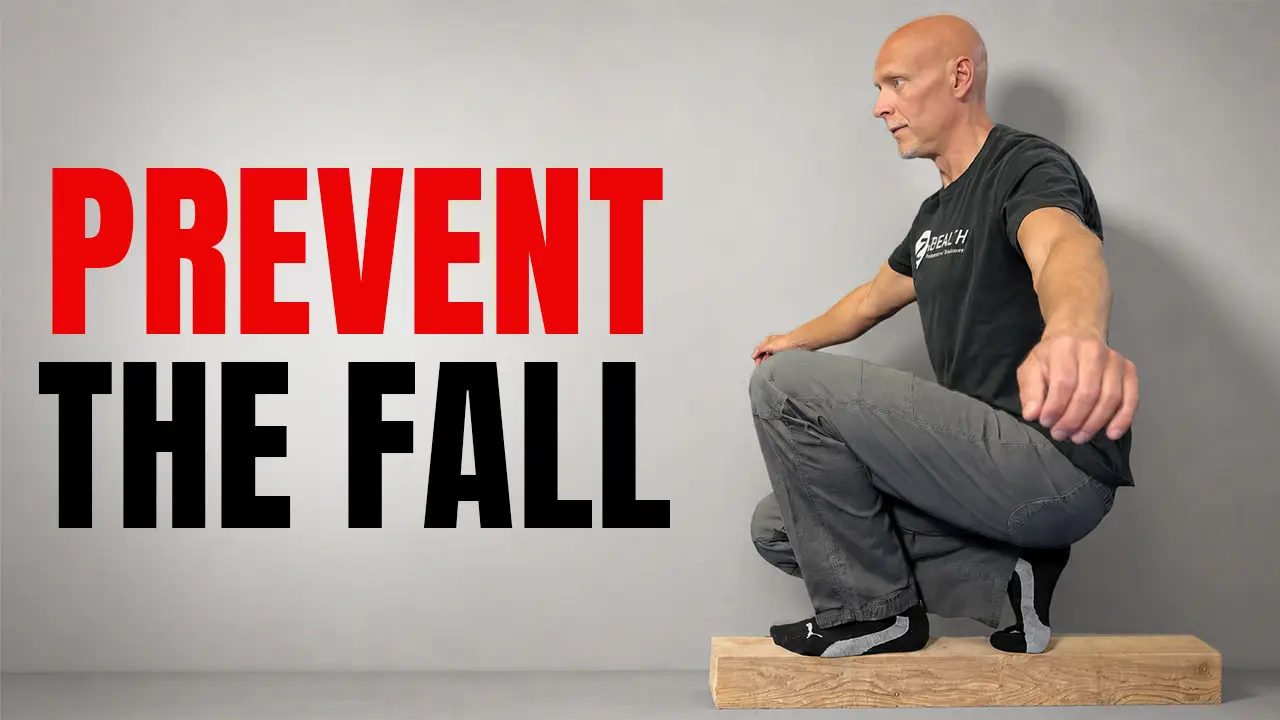
Today we’re talking about the importance of teaching your clients how to get up off the ground after they have fallen. This is actually a lifesaving skill. It’s something you really need to test and then train. We are about a month out from our defying gravity, which is our fall prevention and fall preparation course. So we’re just been for the last couple of months, going through small ideas that are vital and really in, in some cases absolutely lifesaving. And today we wanna talk more than anything about the ability to get up off the ground.
One of the things that we see in the literature is that when people fall, particularly older people, one of the biggest challenges is getting back up to a standing position safely. In fact, when you look into the literature, it varies depending on where the studies are done. But somewhere between 11 and up to 58% of people over the age of 65 when they fall, are unable to get back up simply because they are too weak or they lack range of motion.
Now, the problem that we really run into here is not just that, but the fact that if they are down for more than an hour, these are now called long liars. People that fall and they are on the ground for over an hour. There are multiple studies that show up to half of them may die in the subsequent six months. So falling and being stuck on the floor, unable to move, unable to get up, obviously is a huge issue and a huge problem. And it’s something that we wanna make sure that we know how to address.
Now this is not a super difficult thing to test. So the first thing I’m gonna do is just talk about some basic norms. When you look into the literature, what we wanna see is how fast can someone go from laying on their back to a standing position? And then we can kind of rate that on age.
So here are going to be your basic standards.
50 year olds who are generally fit should be able to get from a lying position to a standing position in under three seconds. 60 year olds, four seconds, 70 year olds, five seconds, 80 year olds, seven seconds. Alright, so 3, 4, 5, sorry, six seconds. So we basically just go up one second as we add a decade.
Now, there are a lot of different ways to get up off the ground. So one of the things that you want to do if you’re gonna test people is just say, Hey, I just wanna get you on the ground. However you’re comfortable. They’re gonna be laying on their back and you’re gonna have them be here. You’re then gonna set a timer and say, go. And you wanna see how quickly they can come up to a standing position. They, again, if they’re under 50, they should be able to do that in under three seconds.
Now, one of the other things that we like to think about in this is once we understand the pattern that they’re using, we then want to ask them to reverse it.
Because one of the nice things is that a lot of the literature shows that if we’re trying to get people up off the ground, the easiest way, particularly for older people to learn this, is to use a backward chaining method of education. Which means we’re actually not gonna start ’em on the ground to learn. We’re gonna start them standing.
So if we think about this, the motion that I just did was a basic sit up to an arm pressure to a half knee to this position. So I would have the my client start here. We would have them gently go down to a half kneeling position, arm down shift to their backside and down.
So we can turn this into a nice kind of slow mobility motor control process, and then we can add speed to it as they begin to improve. One of the things I wanna also encourage you is to use both right arm and left arm for the support phases of getting people up and down off the ground. Because we want to make sure that if in the fall they injure their right arm, if that’s the only thing they’ve ever practiced using for a brace, they need to be able to shift to the opposite side.
So there’s a lot of just basic simple things that you need to take into consideration here. But just remember, we need to test this because if you have people, you get ’em down on the ground and they’re gonna take 6, 10, 12 seconds to get up, we’re gonna see potentially huge issues for them. if they suffer a true fall with maybe a small injury, we don’t want to have them stuck on the ground.
A lot of the ambulance calls that you’ll see in the United States at least, are what are called lift assists. This is for people that have fallen and they cannot get up.
So if you are a movement professional, this is a critical, although seemingly super simple thing, if you’re kind of fit and healthy, but if you actually start testing people, what you’re gonna find are a lot of different challenges.
Now, as a brain-based practitioner, the other thing we have to take into consideration here is what are their other deficits? If your clients have vestibular issues, a history of vertigo, we may have to look into techniques that do not require them to go through big head shifts or head turns as they get up from the ground. ’cause maybe they fell because they’re dizzy already. So then as they try and do something that is untrained or uses a lot of head motion, all of a sudden they’re gonna trigger that vertigo again and make it more difficult for them to get to a standing position to be safe.
So like I said, this is a beginning idea. There’s a lot of detail that you might need to get into if you are really truly focused on fall prevention, fall preparation from a brain-based perspective. But I wanted to make sure you at least had some basic tests that you can start running with your clients.
Alright, if you are new to Z-Health, we are a brain-based education company. My name’s Dr. Eric Cobb. I’ve been doing this for about 25 years. We have 10,000 plus students all over the world, hundreds of thousands of people on social media.
None of that really matters. What matters is, does this information resonate with you? If it does, check out the blogs. We have over 500 of them here on YouTube. Check out our free resources. I’m gonna put in the the description link to a free course that we’re now offering. It’s six hours of online education plus a free ebook just to introduce you to how do the eyes, how do they enter ear? How’s all this stuff interact? How do we begin training it intentionally to improve people? So if you are a movement professional, you’re interested in brain-based training, make sure to check out all these free resources because we wanna make sure that you know that it resonates with you before we start trying to get you to buy anything.
So I hope you have a great week. Make sure that you get some practice in and make sure to test all of your clients.