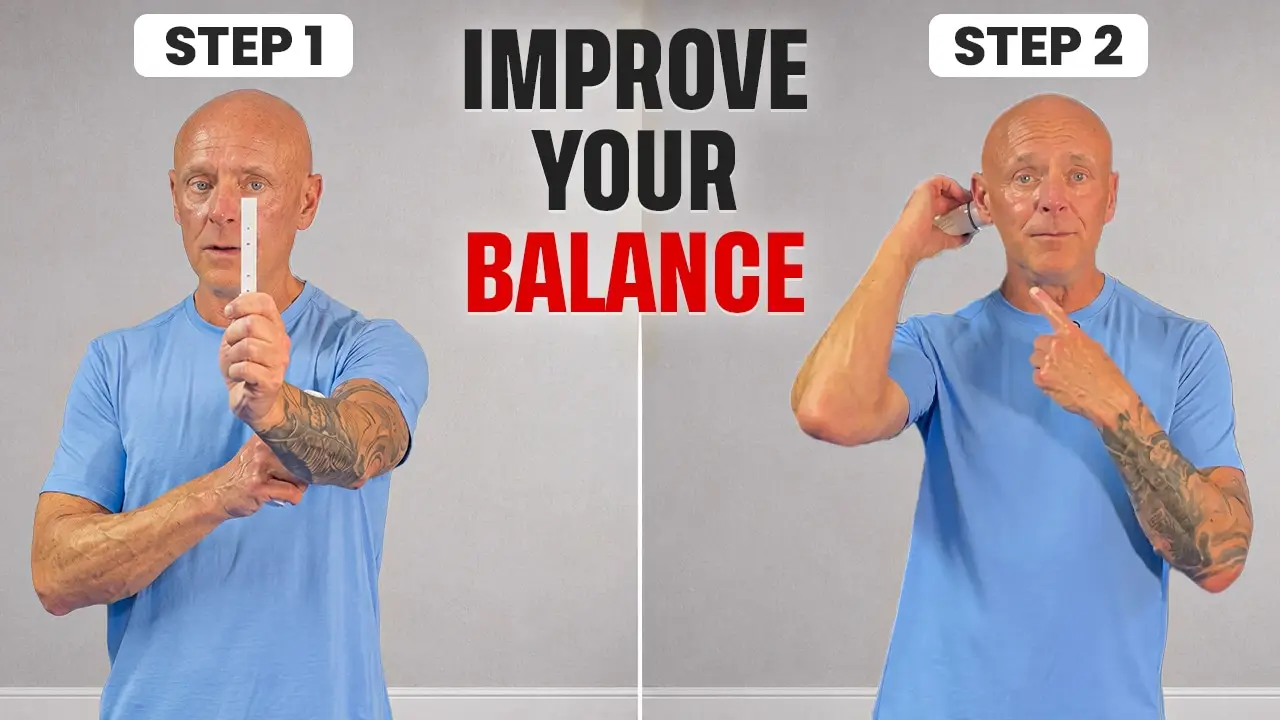
Today, we’re going to talk about breathing and better balance. This is a topic I’ve discussed before, but we are coming up on national fall prevention awareness. and so I wanted to address this one more time. There are numerous studies that look at how strengthening the diaphragm and inspiratory muscles can impact on balance.
Most of this has been studied in what they call community dwelling adults. So basically older people that are living in communities where they’re getting maybe a little bit of assisted help. But in general what we find even in a testing done in like military age folks who are in the military, whenever we strengthen the inspiratory muscles and the diaphragm, really good things happen for posture, for injury resistance, and interestingly enough for balance.
How do you do it? Well, the easiest way to really focus on improving inspiratory muscle strength is to use an inspiratory muscle strength trainer This is a little device called The Breather. I love the company I am NOT affiliated with them so you can buy their stuff and I don’t make any money from it but I love it.
I use it all the time and I would highly recommend that you check it out. There are other companies out there as well that make these devices. And in a pinch, you can actually just breathe through a straw or breathe through your own hand. But in general, if we’re thinking about progressing this, getting better over time, we want to have something with some measurements on it that allow us to really focus in on, uh, performing the exercise correctly.
So how do we improve balance by working on breathing? The protocols that have been tested, and these are double blind placebo controlled studies. Use twice a day exercises done at home with no supervision. People are given a device and they are instructed to breathe 30 times twice a day through the device.
Now, when they do the breathing, the goal is to have an inhalation. Using the device that is roughly 50 percent of your maximal capacity. So we start off giving someone the device and we’re going to set the, there’s a little thing here that says inhale because this one will give you resistance for inhalation and exhalation.
We’re going to set it at one. So there’s basically no resistance on inhalation. So I’m going to put it in my mouth. I’m going to do a quick little breath in. I’m going to go, okay. I’m going to give that a three out of four, or excuse me, a three out of 10, three out of four, three out of 10 intensity. So then I’m going to go to a two, uh, and then I’m going to do it again.
It’s a little harder. That’s a, maybe a five out of 10 and I’m going to go to a three. Okay, that’s getting pretty strong. Uh, so that’s maybe now a six to six and a half out of 10 intensity for me. If I really want to go further, I can check it, go to the four. Ooh, almost can’t do it. And then I go to the five.
And that feels like I am trying to breathe a car in. Uh, so whatever, I’m just trying to breathe harder and harder. So basically what you do is you work your way up. And you figure out, okay, that’s really maximal for me. And then you cut it in half. So for me today, based on other training I’ve been doing, I would be at a three.
The second thing you have to know is that when you do the inhalation, the inhalation needs to be fast and powerful because we are trying to train your inspiratory muscle strength and we need to be able to get air into our lungs very quickly. And the way that we see improvements in the strength of these muscles is by doing a fast inhalation.
So you have a maximum of two seconds. All right. And so it would be exhale, exhale.
Ready? Exhale. I’m going to do that 30 times and then I’m going to take a break. And then later in the day I will do it again. Done over eight weeks, you will see improvements in respiratory function. Often people will see improvements in some measurements of lung capacity. You will see improvements in inspiratory muscle strength.
And believe it or not, we will see improvements in balance and also gait. It is one of the least expensive and most profoundly effective exercises that you will see. Uh, that you can impact the whole body with. And it really takes about three minutes to four, five minutes twice a day. Uh, so I highly recommend you pick up a breathing device and you get started on this.
Now, if you’re new to Z-Health, we are brain brain-based education company. We focus on highly efficient strategies to integrate neurology with what you currently know with biomechanics, kinesiology, et cetera. We are in 110 countries. We have over 13, 000 students. We love doing this stuff and we love showing you how to become a better movement coach through neurology.
So if you’re interested, we have a free mini course, check it out, subscribe to the channel, all the usual stuff more than anything, get something and start breathing.