Today we’re going to talk about your big toe and the possibility that you may have some numbness or pain or something that starts to show up in the big toe and maybe how to think about it. The reason that this came up is I was in a martial arts class a little while ago and got kicked in just above my left knee and I’ve been doing this stuff for about 40 years so that wasn’t any big surprise.
While I felt it during the class, about two days later I started noticing a little bit of numbness. on the top and inside of my big toe. Now, whenever that happens as a movement professional, we have a couple of things we’re concerned about. Number one, uh, we might be concerned about a disc problem in the low back, right?
One of the kind of classic symptoms that we’ll see with L5 S1 or L4 L5 disc herniations in the low back is sometimes people will just complain about, hey, I’ve got this weird feeling in my big toe, um, or in my foot and maybe I feel a little bit of weakness, et cetera. Uh, the other possibility is injury to or inflammation of or entrapment of what is called the superficial fibular nerve, uh, which travels along the outside of the body.
It’s very close to the surface of the skin and then it crosses over the top of the foot and then goes to the big toe. So in my case, I was pretty certain that I got hit, I got a little inflammation, a little injury of that superficial fibular nerve. And so I wasn’t concerned about my low back. But again, if you are dealing with big toe issues, whether that’s weakness, pain, numbness, tingling, these are things that you might need to see a professional about.
And if you are a movement professional, which is most of the people that watch our channel, make sure that you keep this little differential in mind because you may need to do some additional sensory testing and muscle strength testing to really be able to identify, okay, what’s going on. In either case,
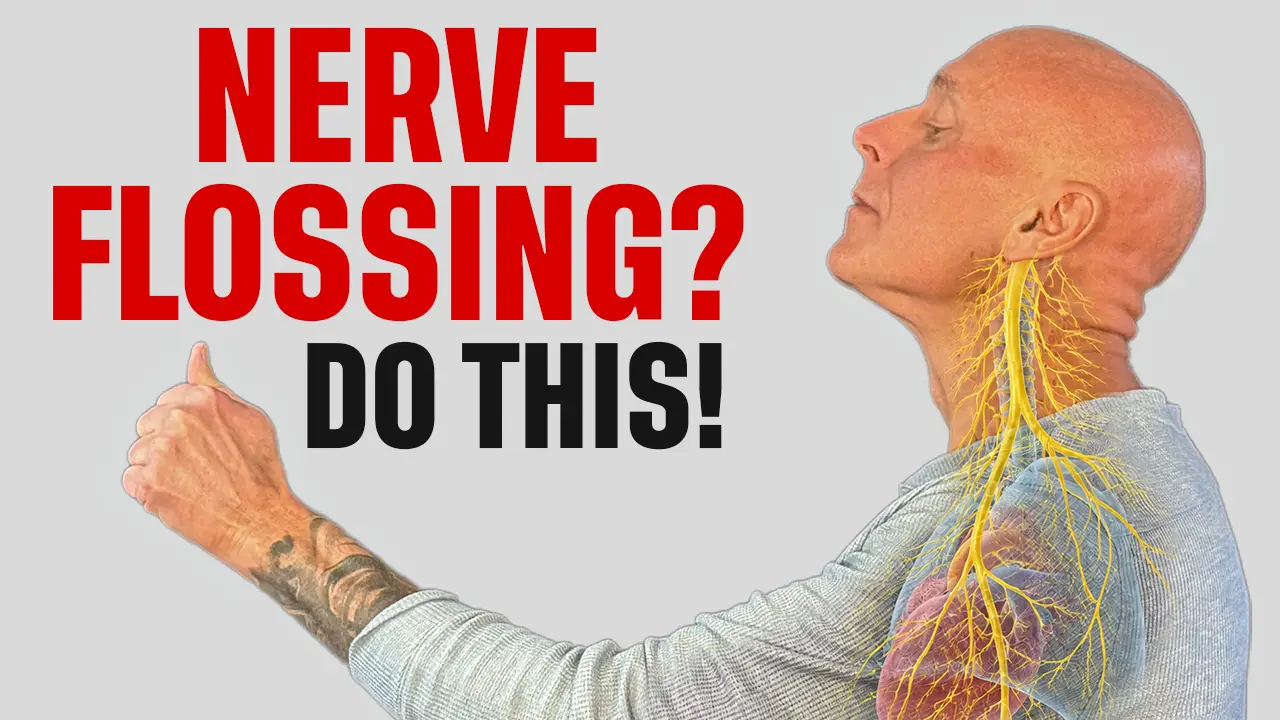
what we may find is that there is one specific what we call nerve Neuromechanic drill or nerve flossing or nerve tensioning drill that can be really effective and that is one for The fibular nerve. The way that we are going to set this up, I’m going to do it standing, Is this. We’re basically going to take the foot in question.
So it’s my left big toe I’m going to put it out in front of me and i’m going to now plantarflex. So I’m going to point my toes toward the floor. I’m going to turn my toes in and I’m now going to curl my toes down. So if I do that from the side, I’m going to hold onto the wall here a little bit so you can see this position at home.
I even will roll my toes down, tuck them here on the mat and drop my ankle out. So I’m now kind of this, uh, support for that position. Just like our other lower extremity neuromechanic drills, once I have the foot in that plantarflexed, inverted and toe flex position. Now it’s all about what I do with everything above it.
My knee, my hip, my low back, my spine. So if I’m in this position, I’m now going to be folding forward, basically doing almost what we would consider to be a hamstring stretch. But once I’m in position, I’m going to start to bend and extend my knee, turn my hip in and out. I might flex and extend my pelvis, drive a little bit further.
I can flex and extend my lumbar spine. I can also invert and evert my ankle and I can flex and extend my toes. The goal here is to feel some kind of nervy sensation, very lightly somewhere between 1-3 out of 10 intensity along the top of the foot, into that big toe area. Once I’m achieving that, I’m going to add a little bit of tension and I’m gonna relax tension and relax.
I’m gonna do that 10 times and then I’m going to stop and then I’m going to do it again and stop. Basically what we’re seeing in current research is that we need to often get a little bit of tension and mobilization of this nerve around a hundred reps per day. So a set of 10, Another set of 10, another set of 10.
You do that 10 times throughout the day. As you’re doing that, you are doing multiple things. You are hopefully primarily decreasing inflammation throughout the course of that nerve, whether that’s beginning in the low back, Or it’s somewhere down further in the leg, in my case, above the knee. Um, and usually what we will start to see, especially if this is a mild problem, that very quickly you’ll start to feel some changes in that tingling, that paresthesia.
Uh, if you have some pain, maybe the pain will begin to diminish. Now, obviously, if you, if you, If getting into this position causes more significant tingling after you’re done, then you’re doing it too hard, or this may be an inappropriate exercise. So if you are not a movement professional, I highly recommend you run this kind of training past whoever is on your healthcare team to make sure it’s appropriate for you.
Uh, but either way, we love utilizing these very specific, what we call neuromechanic drills, nerve flossing drills. Because they can be really, really effective. Uh, and like I said, just because it just happened to me, I thought it would be an interesting one to share. Results wise for me, even though it was an acute injury from a shin, Uh, it took two or three days of allowing the nerve to begin to calm down.
A little bit of other therapy along with the nerve glides and my toe feels great. If you’re new to Z Health, we are a brain based education company. We focus on integrating neurology, uh, with anatomy, physiology, all the stuff that we learn in our classical educational model, but we try and, up level it quite a lot by looking at cutting edge research and showing people how to blend them together.
So if you’re a doctor, a therapist, or a coach interested in bringing the brain back to the body, in a way that makes sense, That resonates with current scientific evidence. Make sure to check out our free mini course to see if this is something you would enjoy. Subscribe to the blog, et cetera., we’d love to work with you.
All right, take care.
Big Toe Numbness — Frequently Asked Questions
What causes numbness in the big toe?
Three common causes: a disc herniation in the lower back (typically L5-S1 or L4-L5) that affects nerve pathways to the foot, irritation or entrapment of the superficial fibular nerve as it crosses the top of the foot, or a sensory mapping issue where the brain’s representation of the foot has degraded from disuse, prior injury, or limited mobility.
Is big toe numbness a sign of something serious?
Usually not. Most cases resolve as nerve irritation calms down or as sensory mapping improves with movement. However, see a doctor if the numbness is accompanied by leg weakness, changes in bowel or bladder control, sudden onset after a fall, or if it doesn’t improve over a few weeks.
How can I tell if my big toe numbness is from a disc problem or the nerve in my foot?
Disc-related numbness usually radiates from the lower back down the leg and may include weakness or pins-and-needles in a larger area. Fibular nerve issues are typically more localized to the top of the foot and big toe area, often after pressure, swelling, or impact in that region. A brain-based assessment using vision and balance tests can also identify when the symptom is driven by central sensory mapping rather than a peripheral nerve.
What exercises help relieve big toe numbness?
Brain-based exercises focus on rebuilding the brain’s map of the foot. Effective techniques include slow toe articulations (one toe at a time), sensory input from different textures applied to the foot, and pairing foot awareness with eye-movement or balance tasks. These improve cortical representation of the foot and often relieve numbness within minutes when sensory mapping is the underlying issue.
How long does big toe numbness usually last?
When the cause is mild nerve irritation or sensory mapping issues, numbness can resolve in a few minutes to a few days once you start brain-based or movement work. Disc-related numbness can take weeks to resolve, depending on the underlying condition and treatment. Persistent numbness beyond a few weeks warrants medical evaluation.