Here’s how to improve your grip strength and your dexterity at the same time.
Whenever we talk to people and we talk about the hands, we often spend a lot of time on the neurology side of this, helping people understand that your hands have a very unique place in your brain. If you go back into the old school version of how brains are structured, we have these things called homunculi. Homunculi are the little people that live inside our brain that basically indicate how much surface area of a given area of the brain is dedicated to different body parts.
When you look at the homunculi, our hands are enormous. Our body’s really small, but our hands are enormous. What does that tell us? Our brains really value our hands, which makes sense because we are tool users and these are the things that helped us survive and thrive as a species. What happens in the modern world, and I guess previously as well, is that very often we have a intense focus on increasing the strength of our hands and using our hands, but we often ignore them. I used to tell people that the most ignored body part in any training program I ever ran across was the hands.
Now, everyone would go, well, that makes no sense because I’m always using them, right, but if we always use them in the same way, just gripping stuff really, really hard, we are beginning to challenge or shape what the brain is gonna be able to do with our hands.
What we want as elite tool users is to have massive grip strength, but also great control. Now, whenever we look into the anatomy, I mean, neurophysiology of the hands, that then leads us to some very, very simple conclusions, which are we need to understand what our clients need. Maybe they have weak grip strength, maybe they have a loss of motor control or fine control in their hands, or maybe they’re dealing with something higher up like elbow issues. What I’m gonna tell you is that we can now look at that from a nerve perspective.
Now, before I get into what we’re gonna do about all this and the exercises, if you are a coach, a therapist, or a doctor, movement professional of any kind, yoga, martial arts, Pilates, if you work with movement, we want to share with you if you’re interested more of this neuro-based education. You can click the link, subscribe to the channel, but more importantly, if you’re really interested in blending modern neuroscience into what you do, you can click the link, we can set up a call and share with you kind of our approach. We’ve been doing this for 25 years. We have over 16,000 students in 120-something countries at this point. So we kind of have an idea of what we’re doing. And again, if you’re a movement pro, I’m sure we can show you how this integrates well. All right, so take advantage of that.
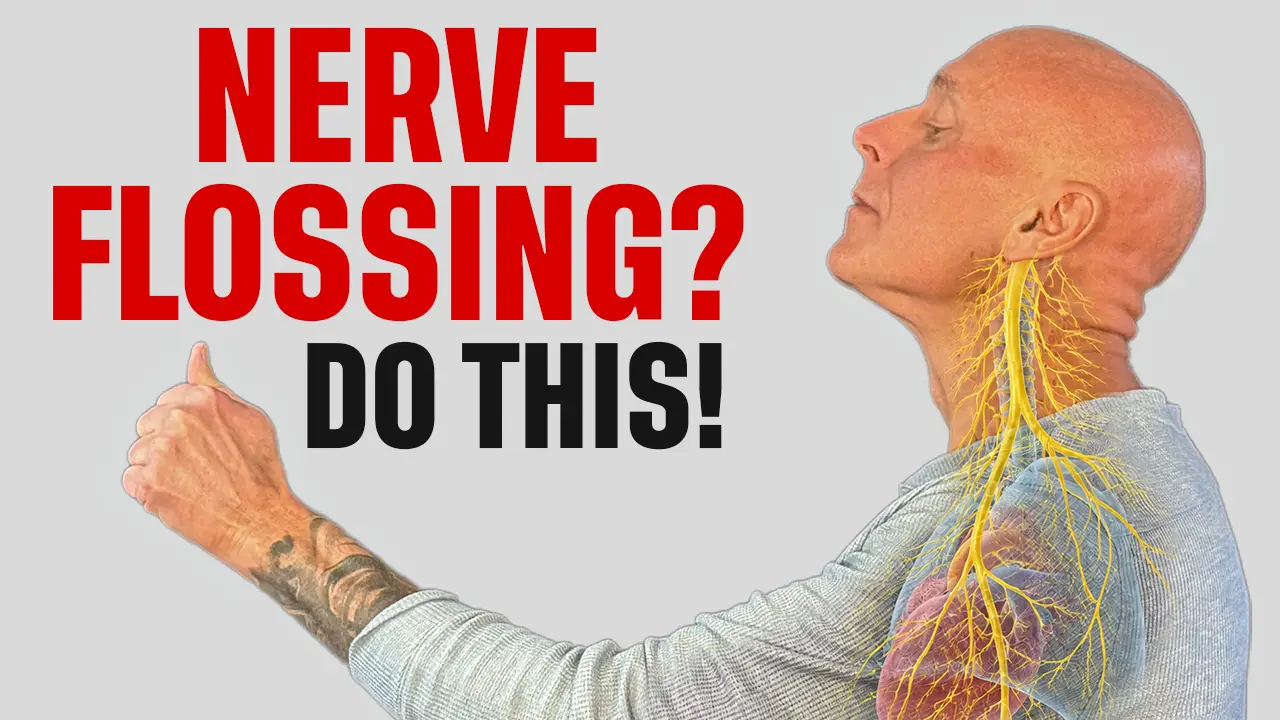
Now, back to this idea. Hopefully, you have seen some of my other videos or somewhere else with what’s called nerve flossing or neurodynamics. We call them neuromechanics because we approach things a little bit differently. But these are specific exercises that put tension on nerves using specific body setups. So for instance, if I was gonna work on my ulnar nerve, my ulnar nerve, typically, we think of the pinky and ring finger on a hand, I would get into this kind of position. Now, whenever we do these exercises, the goal is to tension the nerve or slide the nerve through the tissues because that can change its sensory capabilities as well as its motor capabilities. We then have the median nerve. When we set up for the median nerve, we spread our fingers, we extend our wrists, we lock our elbow, externally rotate our shoulder, depress our scapula, et cetera. Again, I’ve got probably 50 blogs where you can see this. But for the median nerve, we’re now thinking about our thumb, our index finger, and our middle finger.
Here’s why that matters with what we’re just discussing. If your clients have grip strength problems, focus on the ulnar nerve. Whenever we look into what generates more force and how we tend to naturally use our hands as humans, whenever we grab stuff and we meaningfully grab it, like if I’m grappling, and this is actually even taught in judo and jujitsu, like if I grab someone’s gi or their shirt or their coat, when I grab it, I don’t grab it like this. I grab and I rotate so that I hook my little finger and my ring finger into it, and then I can create a super, super firm grip. Most of us, whenever we pick up a baseball bat, we don’t grab it like this and then roll our hand down to it or a tennis racket. We grip it with our little finger and ring finger, and then we roll through.
So whenever we look at the structure of what’s gonna increase our gripping force, just for general work in the real world, ulnar nerve problems, ulnar nerve dysfunctions can become really, really problematic. So if your client has ulnar nerve or grip strength issues, you might find that starting with the ulnar nerve fixes a lot of that. Now, conversely, if I have clients that are struggling with fine motor control, right? And this will happen again through injury, through aging processes, through an overemphasis just on raw grip strength work. Maybe now you ask someone to write something down and you watch and they’re having a hard time actually even just gripping the pen and holding it, or their handwriting is shaky, or they’re trying to move a mouse or use a pointer on the computer and they keep overshooting. There are a lot of different things that could be causing that from the eyes and inner ear, but some of it often comes down to just your ability to individually control the hand, control the fingers, because remember, huge amounts of brain space are dedicated to the hands. So if you undertrain the capabilities, it will begin to create neuroplastic change within your brain, which can cause long-term benefits in some areas, long-term problems in others, because neuroplasticity is, it’s neither good nor bad.
So with that said, when we think about fine motor control, we often will shift from thinking about the ulnar nerve to the median nerve, because most of our fine motor work in the world is not done with our thumb and little finger. It is done with our thumb, our index, and our middle, right? So I’m manipulating things. I’m, you know, whatever, sewing, crocheting. I don’t do any of that, but I do hit stuff with sticks. So if I’m gonna use my hands and I wanna be precise with what I’m doing, I need to know what’s happening here.
So if I have, and can see this with a client, or they tell me something where they’re noticing that they’re having difficulty controlling implements, or doing stuff really quickly or precisely with their hands, I’m gonna now focus on the median nerve. Finally, if they say, well, you know, I’ve been doing all this grip work, et cetera, and I’m now getting a lot of elbow pain, very often what we will see in that particular case is that the amount of gripping that they’re doing regularly is beginning to overpower their extensor musculature. And as a result of that, you can start to develop your typical tennis elbow presentation. Whenever we see that, we’re now thinking about the radial nerve. So just from watching people, knowing what their training history is, knowing what they’re struggling with, in about three seconds of a conversation or 10 seconds of observation, you can already have a pretty good idea of what nerves may be under stress, which ones may be compromised, and which ones you need to be focused on as a movement professional to help them get the most out of their hands.
And remember, again, I’m gonna keep hammering at this. Smart hands typically means a smarter brain because so much of our brain space is devoted to ensuring that these things function well. There is a ton of information and a ton of different approaches to working with the hands. I just think that it is often underutilized and overlooked. So I wanna make sure I share this information with you. And in some of our future blogs, we’re gonna go through different mobility exercises, very specific hand and strengthening exercises because I can tell you this, on a very practical level, if you have clients with wrist issues, elbow issues, shoulder issues, neck issues, thoracic issues, even breathing issues, and dare I say, all the way down to the knee and foot and ankle, a lot of times we can actually trace it back to problems that begin in the hands. Poor hand control, poor coordination, poor proprioception, poor strength, poor sensory information. These things are important, so we have to stop forgetting them, all right? So again, if you are a movement pro or of any kind, a doctor, coach, therapist, make sure to click the link. We’d love to have a chat with you and make sure to subscribe to the channel if you find this interesting, thanks.