Here’s a counterintuitive idea that can change the way that you work with clients in pain. What is it? If they have pain on one side of the body, you may make huge strides for them by training the opposite side of the body. Now that may sound a little bit crazy, but it’s just good brain science.
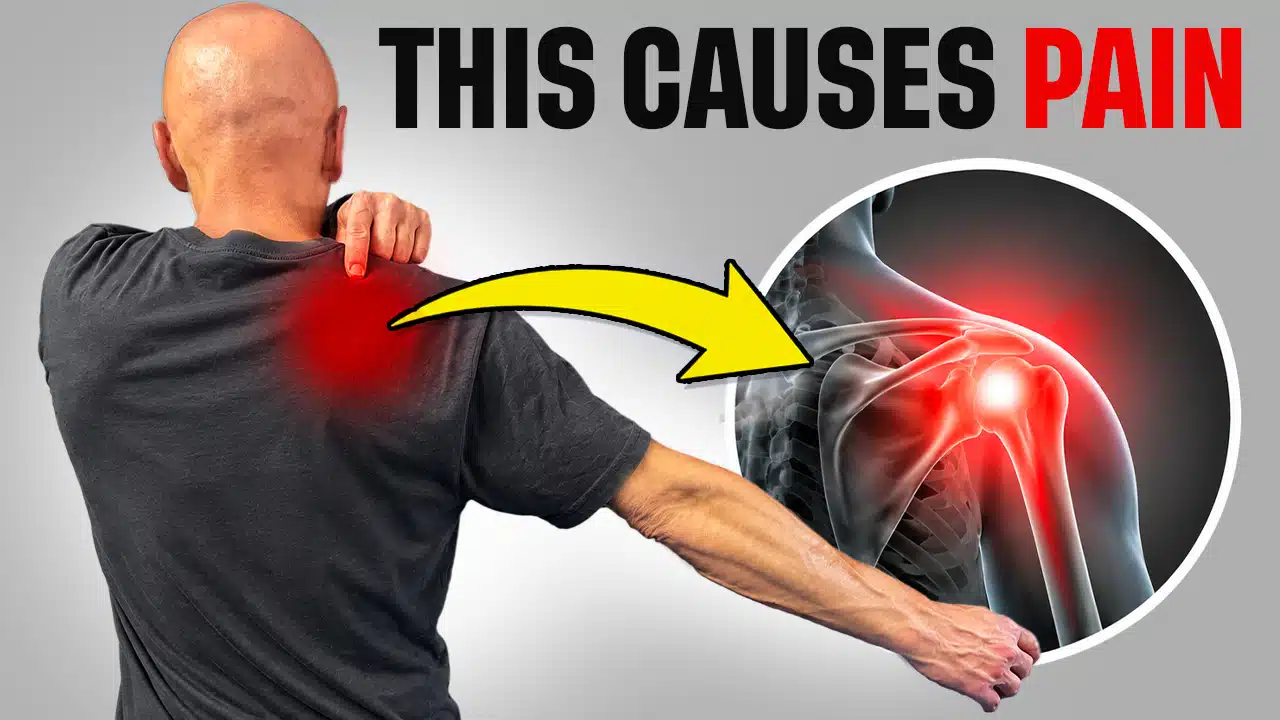
So here’s how this basically works. Someone comes in, they have right shoulder pain. If you’re a typically trained movement professional and you have a big focus on biomechanics, we tend to zoom in on the issue. So if they have right shoulder pain, what are we gonna do? We’re gonna test mobility. We’re gonna test strength. We’re gonna do all kind of testing on the area that hurts to try to identify the tissue that is the problem. But the truth is that pain and movement limitation are brain driven. So if we see someone with motor control issues on one side or strength issues or pain issues, we need to think more broadly than just what’s happening locally in the tissues. And whenever we start to look at it from that perspective, what comes into play is if we understand movement neurology, training the opposite side of the body can make huge impacts on movement, on strength and on pain on the opposite side.
Now, if you are a movement professional and this is sounding interesting so far, go to the pinned comment and DM us on Instagram or drop us an email because we’d love to talk with you more about our brain based education that helps explain all this stuff in depth. But for now, let’s talk about this kind of in brief, but I want to give you a good neuro rationale for why this works.
Basic research on this looks at something called the cross education effect. And what that basically means is if I work on one side of the body because of the way our brains are wired, when I work on my left arm, that’s going to drive a lot of activity or require a lot of activity out of my right cortex. All right. So my right cortex controls the left side of my body. But my right cortex also provides a lot of stability on the same side. It also has some shared pathways for movement on the same side. And most importantly, it’s highly involved in decreasing pain on the same side. So if I work my left arm, I am triggering activity in the right side of my brain, which can go through my right brain stem through something called antinosusceptive pathways that can often decrease pain on the same side. So if I have someone that comes in and let’s say they have right shoulder pain, one of the things that I’m going to be really interested in is can I work their left shoulder? So, for instance, if my right shoulder was hurting in external rotation. Ah! Ow! Every time I go into that motion, I could come using isometrics or other forms of exercise. We’ll talk about that in a different video. And I could then begin working on, let’s say, the same movement with my left arm. So I could be doing isometric work using the basic isometric strap on my left side. And we have done tons of videos on different isometric protocols. But for now, just thinking about somewhere between 6 and 30 second isometrics. Again, in this case, I’m doing the same exact motion on the left arm that I want to improve on the right arm.
When we look at the research literature on this, simply doing the strength work can have a pretty profound effect. Meaning, if I have an injured right side and I work my left arm, we can see somewhere between a 6 and in some studies up to 50% transfer of the strength I’m developing by working my left arm into the right arm that’s doing nothing. It’s not participating. Maybe it’s in so much pain that I’m just letting it rest. I can maintain strength in that side. And we use this post-surgery in all kinds of cases. It’s a really impressive kind of phenomenon of the central nervous system. So it’s something you need to start taking advantage of.
Now, we can improve strength and we can also improve pain. Now, why does that work? I mentioned it previously, but whenever I work on this side, the left side, I’m going to create activity in the right cortex. The right cortex is going to send information down to my brainstem. And it’s going to go through areas of the brain, starting in the midbrain, and it’s going to create activity in what is called an anti-nociceptive pathway. Anti-nociceptive means that when that pathway is active, it’s going to decrease the number of threat signals or the threat responses I’m getting from this same side, from the right side.
So put very simply, if someone walks in to see you tomorrow and they have right shoulder pain or right knee pain or anything that’s ipsilateral, one side of the body, train the same joint on the opposite side. All right, this is kind of the basic starting point. Now, in terms of what exercises to do, we often will start with isometrics because isometrics generally are perceived by the brain as being safe because we’re not having to control a lot of movement. That is a really, really profound tool. And whenever you’re doing it, you don’t have to just stick to one movement. You can do multiple ranges of motion or planes of motion. So I can do external rotation, internal rotation. I can do abduction, I can do adduction. Whatever you want to work on, just create a lot of stimulus in the joint on the opposite side of the one that is injured. When you do that, you’re going to start to see some improvements in strength, usually mobility and hopefully pain as well. And often this can occur in as little as three minutes. Whenever you start to see this, this becomes something that you can assign to them to do at home. And all of a sudden you can start to help solve problems that have previously been unsolvable when we were focused solely on the tissues in the area that were hurting.
So just remember this. Again, it’s a very profound approach and it is very understandable when you look at neurology. If you understand the neuroscience of movement, you will find tools like this all the time. So it’s a really incredible tool. I hope that you find a lot of use for it. So finally, again, if you are a movement professional, you’re interested, again, in exploring this stuff in great depth, looking at all the research and understanding how to apply it, how to assess clients, understand how to use this stuff more efficiently and effectively, make sure to subscribe to the channel or again, go to the pinned comment, DM us on Instagram or drop us an email because we’d love to share with you more information about our curriculum. All right. Have a great day.