Hi Z community, Dr. Cobb back with you.
We’re back in our office doing some exercises to improve our function.
What we’re going to do today is something a little bit unique.
You can think of it as a hand to eye coordination drill. Really, from our perspective it is a cerebellar drill.
The cerebellum is a little brain that sits at the bottom of the big brain. It controls a lot of different things. It controls smoothness of movement, but also movement accuracy.
It’s one of those big things that we talk about. Anytime you see a great golfer, a great tennis player, someone that makes an amazing catch in football, we look at that and go that was awesome, and he’s probably got a good cerebellum.
What we’re going to do today is a little test, a little exercise just to work on both sides of your brain. To do this, we’re going to use some very expensive equipment called Post-it notes and a door. If you can see my little setup over here, I’ve got some Post-it notes put up in a square pattern or actually more rectangular, and I have a center fixation Post-it note.
You can see that I very, very carefully scribbled in some circles, so I have some targets to hit. Here’s basically the exercise. Here’s how it’s going to work. First thing that we’re going to do is we’re going to test something on ourselves.
We’re going to look at a range of motion. I like to test my shoulders, internal rotation. If I stand here, I take my arm down as far as it can go, take it back as far as it can go, I get an idea of how tight that is.

Check that on both sides. If I do this drill, and my brain likes it, that range of motion hopefully will improve, it will go further, or it will feel better. Right now, on this right side, because I’ve been doing some pretty heavy training, the range of motion is not perfect. It’s pretty good, but it feels tight when I get into this position here. I’m going to see if doing some brain training will actually improve my shoulder.
You can test your shoulders, you can go in these different directions, whatever feels comfortable to you. You can test a forward bend or rotations. Do that first. Then, what we’re going to do, I’m going to show you how to do the exercise.
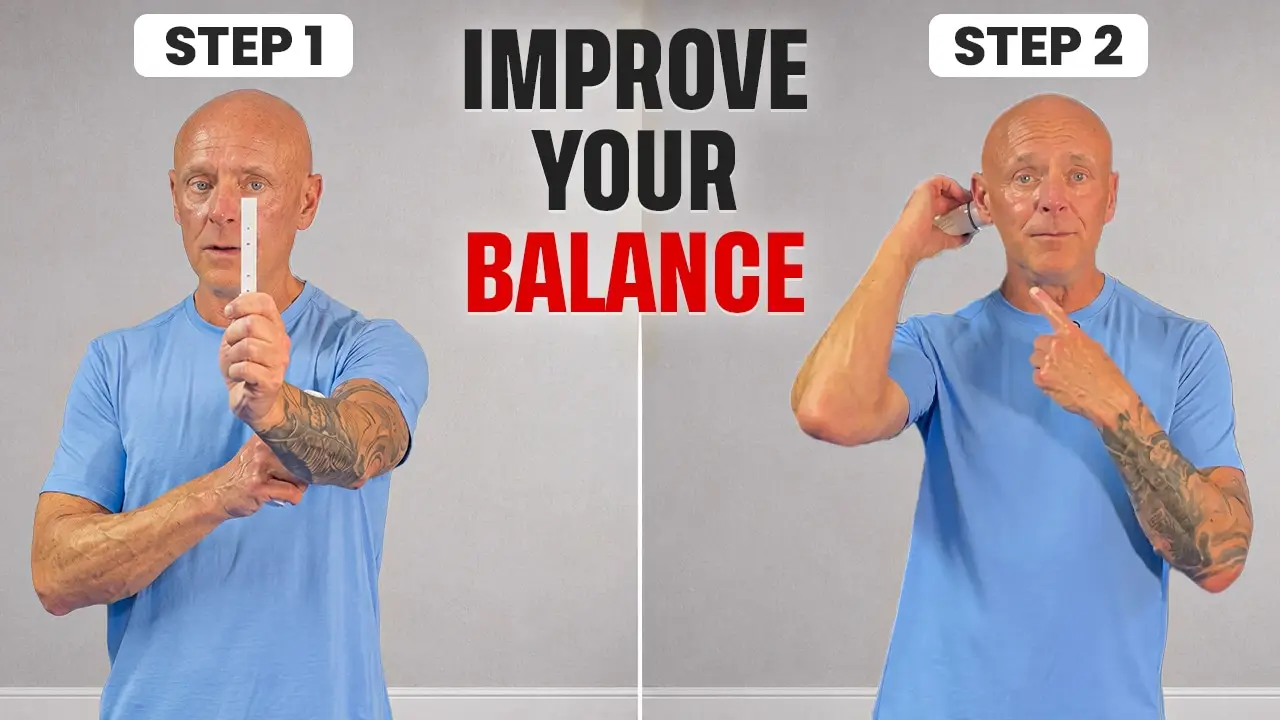
For this exercise, it is called finger, nose … in this case, dot, finger, nose, dot. We’re going to do it by covering one eye. I’m going to start off, and I’m going to cover my right eye. What’s going to happen is I’ll be turned facing the door.
My left eye has to look at the dot right here in the center the whole time. Basically, I’m going to be covered. Finger nose, so I’m looking at the dot. I’m going to make the camera the dot. I’m going to go finger, nose, dot, nose, dot, nose dot. The entire time, I have to be looking at my fixation point.
A lot of people, when they first start doing this, they go finger, nose, and then dot, and they look away. We don’t want that because that’s not going to create this level of brain training that we’re interested in.
I’m going to be here. I’m going to get nice and tall. Cover my right eye. I’m focusing right here. I’m going to reach up, touch my nose, touch the point, nose, point, nose, point, nose point. That’s all there is to it. I want you to do it maybe 10 or 15 times.
Then you’re simply going to retest; much better for me.
What oftentimes happens is normally, when I’m moving the left hand I’m working on the right side of my brain. Sometimes, what will happen is you now do the opposite. In that case, I covered my right eye. This time, I’m going to cover my left eye.
If I cover my left eye, I’m focusing on the dot here, touch my nose, dot, nose, dot, nose, dot, nose, dot, nose dot. Then I retest. Also very good for me. It’s possible that you may figure out that one side or the other, you really struggle with.
If you do find that, maybe if you have a Z trainer, you can talk to them. If you find that you’re going I’m touching my nose, but I’m missing it, and now I’m reaching up and I’m missing the paper all the time, may be worth consulting with someone around. This shouldn’t be that difficult.
Like I said, go ahead and try the exercise. Hopefully, it makes an improvement in your body number one, but also you may learn something that maybe your brain has been missing some information for some time that may explain some of the issues that you have.
Again, very simple, finger, nose dot exercise, 10 to 15 repetitions. If you respond really well to it, do it several times a day. What you may figure out is it really diminishes the amount of stress that you’re carrying in your body from constant computer use and other things that stress out, not only your eye but also your brain.
Give this a shot. If you have any questions about it, please let us know.
Thanks guys.
Have a great week!