If you sit for 10 hours today, try this. I get a lot of questions from people because now sitting is the new smoking and sitting will kill you and I feel horrible after sitting. What do I do? Well, I want you to start to understand that what happens in discussions of sitting is exactly what happens throughout the entire movement world that does not have a brain focus. We begin focusing on tissues.
So what you will typically hear is, okay, well, if you sit all day, when you get up, you need to make sure that you’re stretching your hip flexors, we need to activate your glutes and all that’s fine. There’s nothing wrong with that, but it is incomplete because what you have to recognize is that whenever we adopt any kind of sustained position, sitting for 10 hours in front of the computer, laying on the sofa, then watching Netflix, whatever it is, our brain is a fantastically adaptable organ and it will try to make us better at that position. Now, what does that actually mean? It means that if you understand neurology, there’s a lot more to this than tight hip flexors and inactive glutes, whatever the hell that means. It means that we have multiple systems in the body that are adapting over time to making us better at being in that position. So in order to reduce the impact of sitting on us, we actually have to go system by system and I’m going to show you how to do that right now.
Now, before I get into it, if you are a movement professional of any kind, a doctor, a therapist, a coach, a Pilates or yoga instructor, if you own a CrossFit gym, whatever, and you’re interested in bridging what you currently do in movement with neuroscience, we would love to chat with you. You can go to the pinned comment, you can drop us an email, set up a call because we would love to share our curriculum with you and see if it’s a good fit. All right.
So again, I said, if you sit for a long time, I want you to try this. So we need to start imagining our perspective neurologically. So if I’m at my desk, I’m sitting there and I’m going away on the computer, what’s the first thing that I’m actually going to need to address? My eyes. Why? Because 50 to 70% of our brain is dedicated to processing visual and vestibular input. So we have to address the eyes first. If our eyes are fixed into this near focal point perspective, it’s going to cause issues through the whole body. So the first thing that you want to do is you want to get up and you want to start looking into the distance. When I say look into the distance, I mean, look into the distance as far away as you can. Go outside. Believe it or not, there’s a world out there that’s in the distance. I need you to go look at it and not for 12 seconds. Remember, you just spent 10 hours staring at a screen, hoping that good things would happen. Now I need you to go out and you just spend at least 10 minutes, if possible, longer would be better, but at least 10 minutes per day, looking at the distance. We also recommend what’s called the 20, 20, 20, which is every 20 minutes, you need to look away from your desk, at least 20 feet away for 20 seconds, right? That’s a very simple kind of mnemonic to remember. 20 seconds is great. Spending a little bit more time is even better. So we need to break this near focus first.
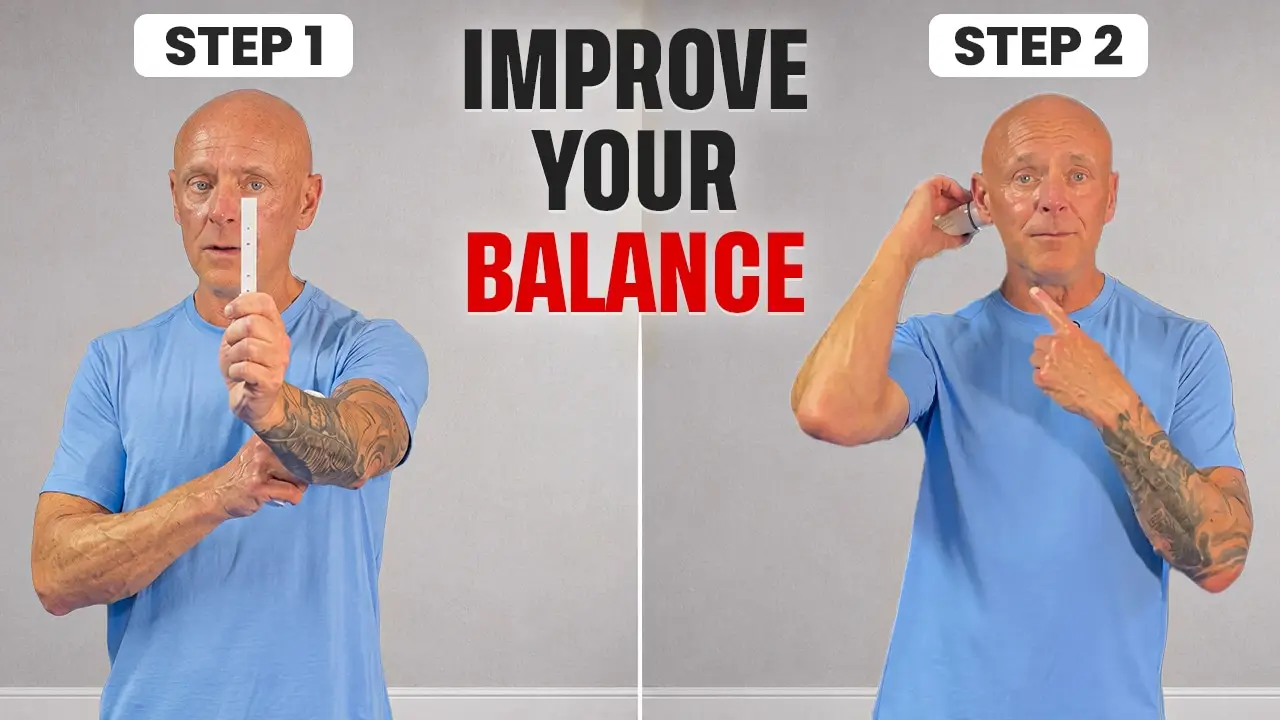
Then we want to address the vestibular component because again, what we’re doing is we’re staring at our screen and we’re fixing our head in place. So we now need to start increasing vestibular stimulation. So after I’ve done my distance, or even while I’m doing my distance vision, I want to also begin doing some VOR work. But what does that mean? It means I’m going to stimulate my inner ear by staring at a target, keeping my eyes on that target while I go through different head motions. Those motions can be right and left rotation, flexion extension. I can do diagonals. I can do circles. I don’t really care in the beginning, just go slowly enough that it doesn’t make you nauseous or sick or dizzy, but I want you to accumulate some time disassociating your eyes and your head. All right. We need to stimulate the vestibular system. There’s a lot of other ways we can do that. Walking forward, walking backward, going up and down, stepping side to side. You can do all that while you were moving your head. All of that would be fantastic again, for breaking kind of this centralized fixation perspective that we get when we sit all day.
So after we deal with our eyes and after we deal with our vestibular system, we then need to start to deal with the proprioceptive system, the stuff that people get really excited about. Your tight hip flexors need to be stretched and your glutes and all that kind of stuff. Lots of different ways that you can do this. One of the simplest ways that I like to have people work on the hip flexor issue is a simple half kneeling stretch where I’m going to get down onto the floor. Now I’m going to do a couple of things here that maybe will make this a little better for you in terms of waking your brain up to the fact that you’re supposed to be a upright bipedal organism, not something that sits in a chair all day. So when you’re in this position, what I want you to do is your back foot, you can see I have my toes up. I’m going to actually push my big toe into the floor. All right, I’m going to grab the floor with my big toe and the rest of my toes, but really the big toe. As I do that, I’m going to tighten up this glute. I’m going to tuck my pelvis. Now, as I start to drive forward, I’m also going to take my left big toe and push it into the ground. I’m going to pull this heel back. So I’m kind of in this relatively rigid posture position, but I’m engaging my feet. I’m engaging all the musculature. And then I’m going to take my opposite arm. So it’s my right leg’s back. I’m going to take my opposite arm up into the air and I’m going to kind of drive forward. And I will do all that all at the same time. And then I’ll switch sides. The reason that I want you to do this is that you’ve spent the entire day like this, forgetting the fact your brain goes, oh, right. Whenever we walk, my left leg works with my right arm. I need to actually get that coordinative pattern reestablished. So that’s one of the easiest ways to do that. I guarantee once you do that a couple of times, you’ll stand up and go, oh, I feel better. I’m much taller.
After we deal with proprioception, we also have to deal with our breathing because once again, I’m here. I’m focused. Everything becomes more stable and stiff. And I also typically start to breathe in a upper chest manner. All right. So rather than expanding my diaphragm, you don’t have to breathe deeply the entire time you’re sitting at your desk. It’s fine to breathe shallowly, but you don’t want to forget how that’s a problem with spending 10 hours seated or 15 hours seated. We forget that our diaphragm is meant to descend. Our rib cage is meant to expand. So after you’ve done all this other stuff, I want you to then do some banded breathing. You can grab a band. If you have one, if not just take your fingers, wrap them around your lower ribs. Try to imagine you have pinchers or whatever, like a lobster. And then you’re going to take deep breaths in and out, trying to expand the rib cage three-dimensionally. All right. I want you to do five to 10 of those. If you put all this together, it’s going to take you roughly 15 minutes or so, maybe 20, if you’re really dedicated to it. Now I know that sounds like a long time, but it’s 20 minutes compared to the probably in real life, 14 to 15 hours a day that you spend sitting.
I guarantee if you try this for a week, at the end of that week, the kind of beat up feeling that you get from spending all day in front of your computer and then going home, watching TV all night is going to be massively reduced. And overall, you’ll be able to move better. And I guarantee that you will feel better.
Now, if this doesn’t work for you, it means that there’s probably some other issues that have to be addressed. But this again, approaches this not from the biomechanical model of, hey, you just have tight hip flexors and your glutes are turned off to, hey, what actually happens to me from a neurologic or brain-based perspective when I sit all day? So we have to look at every system. We have to change the inputs. We have to reverse some of the stuff that we’ve been focused on through the day, because again, everything that we do, our brain is going to make us better at, and we don’t want to become experts at sitting. We want to remain experts at moving, which is the whole point for us as human beings. All right.
So once again, if you are a movement professional, you find this stuff interesting, click the link, check the pinned comment, email us, set up a call. We’d love to share this information with you. We absolutely love bridging the gap between biomechanics and neuroscience. Biomechanics are awesome, but they are incomplete when it comes to helping people optimize everything that they want. So again, if that’s your mindset, we’d love to chat with you. Otherwise, enjoy this little protocol. I hope it works well for you.