Today we’re going to look at one of my favorite exercises for ankle pain, and recurrent ankle sprains.
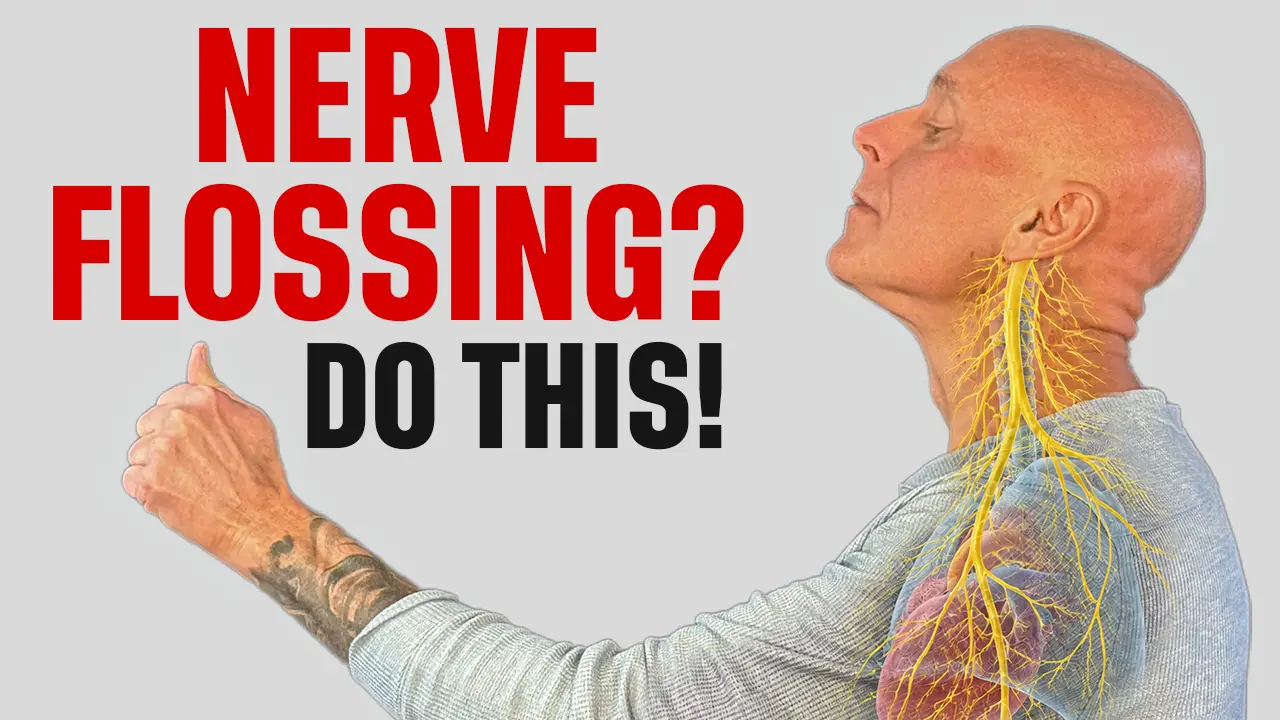
If you’ve watched a lot of our prior blogs you know that we spend quite a bit of time going through what we call neuromechanic drills, which are specific exercises designed to basically floss specific nerves through surrounding tissue.
When you look at how information goes from the skin, muscles and tendons, etc., up to the spinal cord and brain, the primary passageway is the peripheral nerve. Very often peripheral nerves can be entrapped, or basically restricted by surrounding tissues, and that can cause a lot of issues.
Today we’re going to take a look at a nerve called the sural nerve.
I have a little picture of it here for you. The sural nerve is coming down here on the outside of the leg, and you can see it goes back behind what’s called the lateral malleolus, or your outside ankle bone. Why this nerve is really interesting and important, is it is what’s called a cutaneous nerve, or sensory nerve. Meaning it doesn’t innervate muscles, it basically provides sensation information from the outside of the leg, and around the outside of the ankle.
Where we see this particular nerve being a problem very often are people with Achilles tendinitis. Lots and lots of runners, football players, whatever, often will complain about Achilles pain, also dancers. This is great if you have recurrent Achilles issues, also if you have recurrent ankle sprains.
Let’s say you have the right ankle, you sprained it 10 times in your life, and you’ve never done anything to the left side, there can be other issues for that.
One of the reasons we think that happens is that initially when you first have an ankle sprain you can have scarring occur around this nerve. Now all of a sudden the information that should be coming from the skin, etc., where the sural nerve innervates, your brain may not know that area anymore. It has lost communication to some degree, and so you become a little bit more prone to having additional injuries.
It’s a really, really simple exercise, one our neuromechanic drills, which basically takes nerves, and we put them under tension, and then we move them back and forth. I’m going to take you through the setup for this, and the way that I’m going to do it, I’m going to do it standing to begin with using a chair.
You can do this seated in a chair if you have a really serious tension, or hamstring flexibility issue, it doesn’t really matter, or balance issue, do it seated. Otherwise, you want something that’s a comfortable height. All I’m going to do is I’m going to put my foot up to begin with, and I’m going to start in a nice tall posture.

In order to get to the sural nerve we have to do primary things with our ankle. First we have to do what’s called dorsiflexion, so we’re going to be pulling the toes up toward the knee. We’re then going to invert where we’re going to take the sole of the foot and move it toward the midline. I need to pull up, and rotate the foot in, and I need to hold my ankle in that position. Once I’m in that position, depending on your level of tension in this nerve, you now can start to add in spinal curves.
You can tilt the head and neck down, around through the mid back, around through the low back, and all that you’re looking for is to increase tension along the outside surface of the lower leg, and around the ankle. This can be particularly helpful if you are experiencing ankle pain. Basically, in the distribution that you’re seeing up on the screen. Once I’ve gotten into a position where I feel tension in that area, let’s say me coming here, tucking my chin down, gives me enough tension that it’s a 3 out of 10. That’s what we’re looking for in terms of sensation, about a 3 out of 10 intensity, nothing higher than that.
Once I’ve found that 3 out of 10, I’m now going to hold that position, and I’m going to start to do a little flossing action. The easiest way to do that is to use your knee, so I’ll be here, and I’m going to flex my knee to take some tension off the nerve, and then I’m going to extend, put the tension back on. I like to do that maybe 5 to 10 times, and with each successive repetition if I can go a little further into it, around a little bit more, so I can maintain that 3 out of 10 tension, that’s what I’m looking for.
The primary places that I have people work on the sural nerve in terms of what joints to move is I have them use the knee. I will often have them use the ankle. In order to use the ankle you have to have everything else tight, and you’re just then pointing the toes, and then pulling them up and turning in, so 5 to 10 repetitions like that. You also can very often if you rotate the trunk, so rotate your torso toward the leg. My right leg is out, so I’m rotating from my low back to the right, that also can get a nice flossing action for the sural nerve. This technique can also be useful in alleviating ankle pain.
In general, if you respond really well to this it decreases discomfort, makes the ankle feel more stable.
You want to work on these drills maybe twice to three times a day. For me, as I said, I like to do maybe 5 to 10 reps with the ankle, 5 to 10 reps with the knee, 5 to 10 with the low back. Making sure that you’re never going over that 3 out of 10 intensity.
If this is something that you struggle with, Achilles tendinitis, ankle sprains, also some people with plantar fasciitis, pain in the bottom of the foot also will respond to this sometimes.
Give this a shot, and I hope that you find it really helpful. If you have any questions let me know.