We’re gonna be working on another version of cognitive training with movement, right? Thinking while moving, and as we’ve talked about in previous videos, whenever we add cognitive training into our work as movement professionals, we have to understand the different domains of cognitive capacity. This is one of the things that’s so important if you’re going to work with people from a brain training perspective or a brain rehabilitation perspective, it’s not enough to just say, Hey, we wanna do a little cognitive training, so do some sudokus every day. That is not what we’re after here. We want to actually be very precise, understand things from a neurologic level. So today we’re gonna talk about something called Design Fluency.
There’s an overarching domain in when in cognitive training called cognitive flexibility. Cognitive flexibility is exactly what it sounds like. Can you think differently? Can you come up with new ideas? Can your brain remain resilient when it needs to adapt? So whenever we look into the subcategories of cognitive flexibility, we see verbal fluency is one of them, which we’ve already showed you a couple of ideas on that.
But the next is called design fluency. Design fluency in the movement world is probably one of the more fun cognitive tasks that we can work on. ’cause design fluency, we can do via movement. So the exercise that I’m gonna have you do today. Hopefully, pretty much every day for the rest of your life, is a very, very simple sounding exercise.
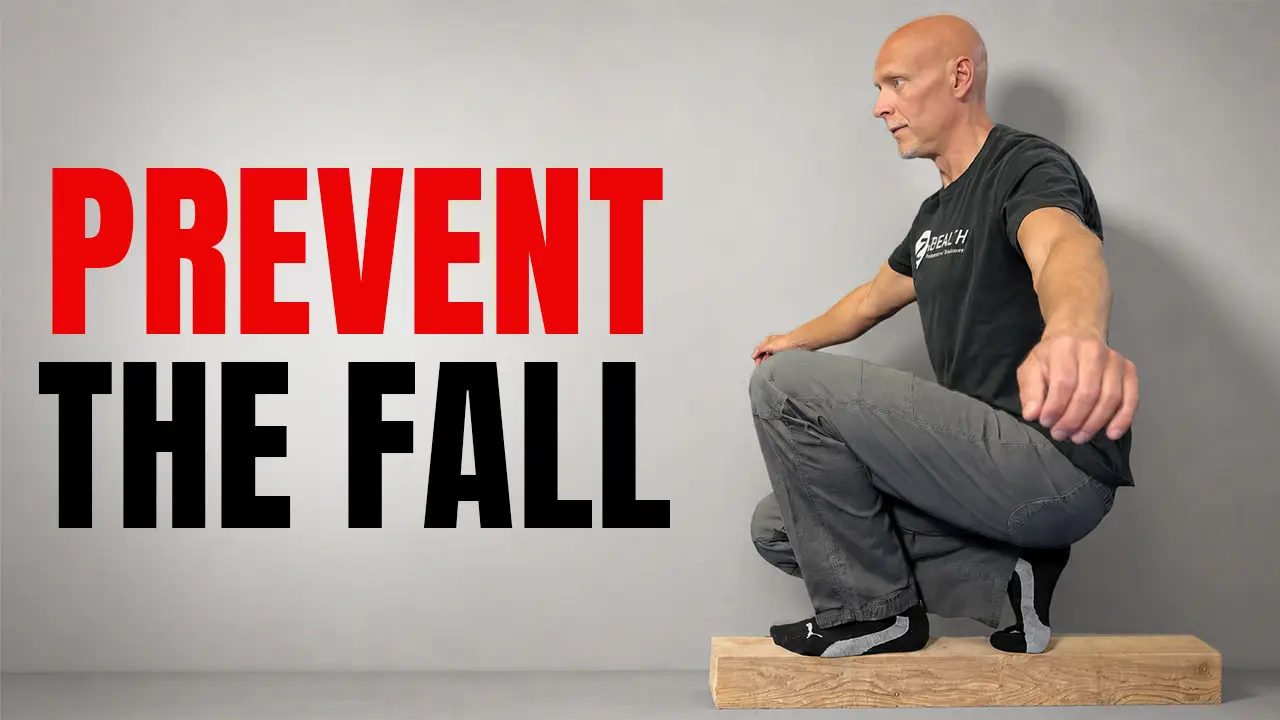
It’s just called Five Ways Up and Down. Now, what that means is that you’re gonna set your timer. I recommend that you set your timer for between 30 seconds and one minute. When you hit the go button, your job is very simple. You have to get down to the floor and back up five different ways. All right or whatever timeframe you give yourself.
There are no rules about using your hands, not using your hands, using a wall. Not using a wall. So if I hit my buzzer and I just wanna start off doing something really simple and coming back up, that’s fine. If I hit my buzzer and go, you know what? I like to use the wall to get down to the floor and push back up, it’s fine.
It doesn’t have any rules other than, five ways down, five ways up that are different than the previous version. Why this is such an important drill is that in the movement world, we are very dedicated to perfect form and perfect repetition, which is great, especially when we’re under load because that is a safer way to train.
But in real world function we virtually never do anything exactly the same way, right? We don’t bend down to pick stuff up out of our closet like we would do with a kettlebell, right? We’re getting the dog and cat outta the way and we’re bent over and we’re doing all kind of crazy stuff. And we wanna make sure that our brain remains adaptable and resilient in the face of different movement challenges, and that it can be creative in problem solving.
And this is one of the easiest ways to work on it. Now, if you are in a role where you’re doing fitness work as well as rehab work, you can also make this much more challenging. I often will have clients. Start this kind of exercise, but it’s a five minute drill. They have to start on the floor, they start standing up and for five minutes, they are constantly trying to figure out a new way to get up and down off the floor.
Five minutes of that is gonna get their heart rate nicely elevated. So in terms of a warmup, as opposed to walking on a treadmill for five or 10 minutes, doing something that has a huge design fluency challenge, built into it along with up and down off the floor, which is gonna elevate cardiovascular activity. I find is a much better and longer term a much more beneficial, longer term approach to getting people ready for a training session.
So it’s an easy, easy thing to implement. Just don’t be surprised that at some point after four or five different repetitions. People kind of freeze. They’re like, I don’t know how else to get up and down. All right, we’ll take a breath. Think about it. Figure it out. This is how we keep working on the capacity to think while moving, which is really what we’re trying to emphasize here.
Give it a shot. I hope you enjoy it. I think you’ll find it incredibly useful. And if you do find it useful, do it a lot. And you can obviously do something other than just getting up and down off the floor. I don’t really care. You can do design fluency with virtually any type of movement practice.
We’re super excited to announce the fact that we have just released our Cognitive Training module from our Brain-Based Practitioners Guide. If you are interested in blending cognition with movement training from a cutting edge perspective, make sure to check it out. If you’re new to Z-Health, we are a brain-based education company.
You can check out our free resources, subscribe to the channel, and learn more about us to see if. If you are a movement professional, you’re a doctor, a coach, a therapist, and you’re interested in blending, cutting edge neuroscience into what you do, we’d love to see if we could be a good fit for you because we are all after the same thing, which is healthier, happier clients, and a lot of what we do can be a huge assistant in that.
All right, take care. Have a great week.
Want to learn more? Check out our free mini course.