We’re gonna discuss using an eye movement drill today to work on your cognitive capacity. We’re talking about cognition in this latest series, and the need for movement professionals to include cognitive training into all of our exercise movement and rehab work eventually, because thinking and moving at the same time is actually really challenging.
And if we wanna prevent cognitive decline and we want to help people go through cognitive rehab after brain injuries or maybe as a result of metabolic dysfunction like diabetes, we have to understand how to blend these things together. We mentioned in a previous video that one of the most important parts or important functions of the human brain, particularly the frontal lobe, which is where, we typically find our executive functions is inhibition.
In other words, for us to do good long-term planning, for us to plan, to focus on something, to memorize it, et cetera. That’s the job of the frontal lobe. Also, whenever we look at movement inhibition our decision to not make a bad movement, our planning as I’m gonna take a step over a hurdle to make sure that I don’t initiate that too quickly and then stumble a trip and fall.
A lot of that is based off function coming outta the frontal lobe, and the term that is given to it is inhibition. So this is one of the most important cognitive skills that we can have as human beings. As people go through cognitive decline, you will often see a lack of inhibition in their behavior.
They become irrational, angry. A lot of things will happen because the frontal lobe is no longer able to say, Hey, rest of the brain. Let’s take a, take a breath, take a pause, and make sure that this action we’re about to perform is the right one. So can we train that? Absolutely. One of the easiest ways to train inhibition is the use of an exercise called anti-saccades.
Now a saccadic movement is talking about the eyes. saccadic movement basically means I’m looking at an object, let’s say over here, and then I quickly shift my focus back to the camera, or I’m looking at the camera and I shift my focus over there and back. That’s a saccadic movement, right? Just a quick jumping of the eyes from one focal point to another.
Reflexively, the way that the human nervous system functions is if I’m looking at the camera and then suddenly my cat charged out of the door, and I, I picked up that movement outta my peripheral vision. My eyes would saccade. to that object and make a quick decision about, is this something to be scared about? Is this something I need to address or can I ignore it?
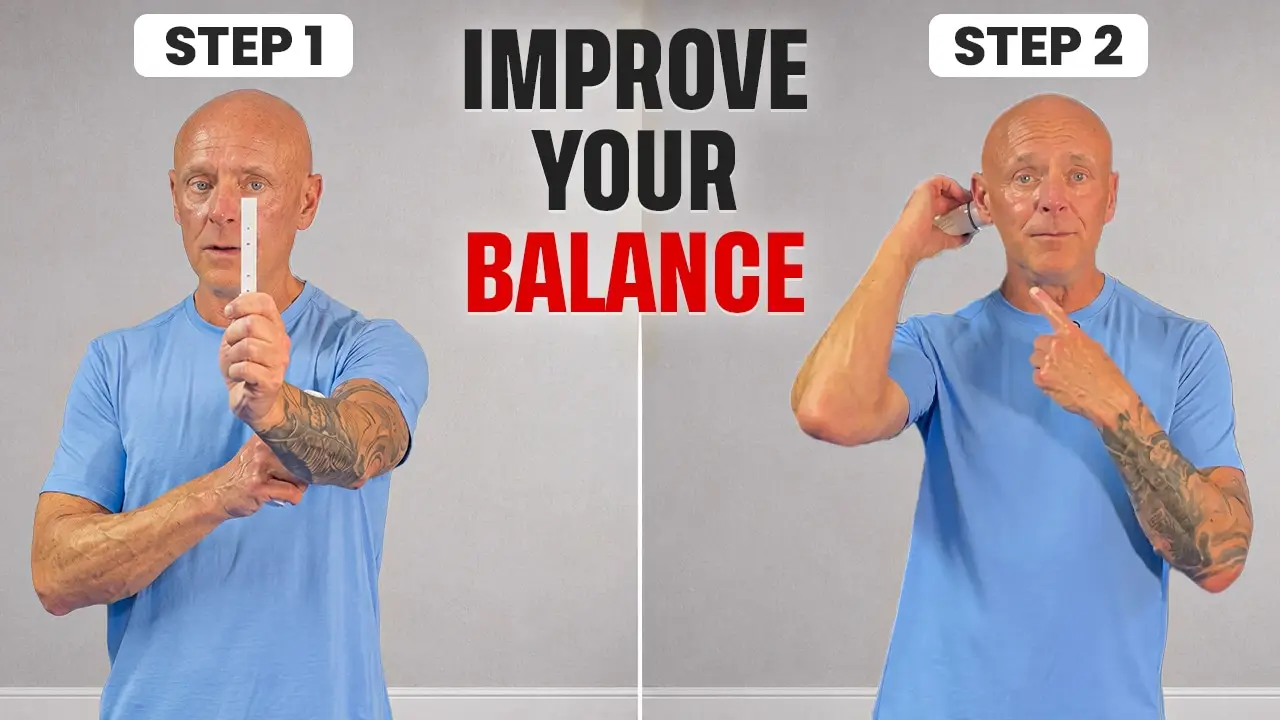
That is a reflexive response. Meaning anytime I’m staring at something and I see movement reflexively, my eyes are gonna want to go to that movement. So an anti-saccade means that I’m going to inhibit that desire to look at the moving object. And instead, I’m gonna look at something else. So the way that an anti-saccade is done in a kind of clinical setting, if I was testing you, I would say, okay, look at my nose.
I’m gonna put my fingers up like this. And I would tell you when my, when I move this finger, look at the other one in. In this instance, let’s say I’m looking at the camera, that’s your nose. These are your fingers. You move this one. I’m gonna look at this one over here, right? That’s an anti-saccade. What I’m gonna do is I’m gonna play a little video for you.
Now, this is one that we use in our, some of our courses is we’re starting to teach anti-saccade, and this is an anti-saccade test for you. It’s an 18 second video. Alright? So things are gonna be moving fairly quickly. What you’re gonna see is in the center, you’re gonna see a Z for Z Health. A little circle, and then you’re gonna see two different dots on either side of the screen.
At some point, one of the dots is gonna begin spinning, or it looks like a coin. It’s gonna be in spinning. Your job is to not look at the spinning one, but instead to look at the other one, and then as soon as you’ve looked at the other one. Switch your focus back to the center. It’s very self-explanatory once you get going on it, but your job is to do the 18 second video and count up how many times you made a mistake.
This is something that you can improve with training. This is an inhibition exercise.
Now if you then wanna make it more difficult and you wanna do some of the stuff that we would do with our clients and our athletes, rewind the video, play it again, and do something, add something to it to make it even harder. So in other words, that would be adding movement to the mix. I often like to have people do either a unilateral, or let’s say a bilateral motor control drill while they’re trying to do anti saccades.
And what you’ll see is as we layer movement challenges, especially more complex movement challenges to the anti saccade work. It gets tough, and that’s a good thing. Cognitive training coupled with movement will be probably among the most tiring things that you do, but the more you do it, the better you’ll be at it.
And here’s the kicker that’s gonna give you far greater transfer into your daily life, as opposed to, I’m now going to foam roll my tricep to get more flexibility. We want you to be able to use your body while you are doing other tasks and to have your brain do all that seamlessly. And a big piece of that is your ability to inhibit.
So this anti-saccade exercise is a fantastic way to do so. and you can do this in a lot of different ways, in exercise. Like we’ll often have people have maybe two kettlebells or dumbbells. Speaking of cats, two kettlebells or dumbbells, they’re here and I’m standing in front of them. I say, okay, look at my nose.
And whenever you see me raise my right hand, you’re gonna press with your left hand. And weirdly enough as, as silly as that sounds, the impact of exercises like that are profound over time. So give all this stuff a shot. Super excited to announce the fact that we just released our Brain-Based Practitioners Guide to Cognition Training module for sale.
So if this is of interest to you, you guys are loving this idea of blending cognition and movement together. Check it out. If you are new to Z-Health. We are a brain-based education company. We work with doctors, coaches, and therapists from all over the world. So if you’re interested in blending neuroscience with what you’re already great at, to give even better results to your clients, make sure to, to subscribe to the channel, check out our free mini course and reach out to us.
We wanna make sure that we are,, giving you the help that you are interested in. All right. Take care.
Want to learn more? Check out our free mini course.