Carpal tunnel, hand pain, wrist pain, and weak grip. All of these are often problems that people
deal with and they have a similar route. They’re typically problems with how the nervous
system is supplying information from the hand and how the hand is supplying information to
the nervous system, right? We have this kind of bidirectional communication going on.
So in order to solve grip issues or pain issues, we often have to look at three specific nerves that
are going to feed the hand. The median nerve, the ulnar nerve, and the radial nerve. Whenever
we work with them appropriately, in a targeted way, we can make enormous changes in grip
strength, pain, and mobility very, very quickly. You just have to know how to do it correctly and you also have to make sure that you are addressing the correct one.
All right, so a couple different things I want to cover first is the testing process. We want to, whenever possible, test sensation and motor. Now, what does that mean? It means that the skin, right, can sense light touch. It can sense warm and cool. It can also, as we go a little deeper, it can sense pressure. So generally speaking, if you are a professional, you should be doing full sensory workups on people who complain of carpal tunnel issues, grip strength issues, or pain issues. Because you have to know what sensory problems they have occurring because there’s a lot of cool stuff that you can do to augment the basic exercises once you understand that. Whenever we’re testing the hand, we have to test the palm side of the hand and the back of the hand. Again, because we have different nerves involved in sending signals to the skin, cutaneous tissues, and joints and muscles. So to be thorough, it is important that you actually, even on your own body, have someone that you trust, you know, close your eyes, and have them stroke one thumb and then the other. You go, okay, that feels pretty similar. And then middle finger, oh, that’s really different. You want to identify which thumb or which finger maybe has sensory issues. And then if you’re doing testing, grip strength testing, kind of cool devices that you can get that you can test your index finger and your middle finger and your ring finger. And I had one here and I just, I put it down somewhere in the midst of filming another blog. And anyway, I won’t waste your time. But you can test individually. You can also grip something really hard, grab a bowl or a jar. And as you start to squeeze, pay attention. Do I feel like I can create a lot of pressure with my pinky as opposed to my index finger? And I’m not saying it’s the same amount of strength, but I am saying that you should feel connected to each finger in the same way. If you don’t, that can tell you a lot.
So let’s discuss the anatomy. If I feel disconnected, a loss of sensation, or I don’t really feel like I can contract hard, inflection with my thumb, my index finger, or my middle finger, that’s your median nerve. If I cannot feel or contract hard with my ring finger and little finger in flexion, that’s my ulnar nerve. And then if I cannot comfortably extend my fingers equally, and if I test them, feel like I’ve got good pressure resistance in each finger, that’s my radial nerve. So there’s your list. Median nerve, ulnar nerve, and radial nerve. So we’ve talked a little bit about assessment. Again, if you’re a movement professional and you want to know how to do this stuff more appropriately and more quickly with your clients, this is what our entire curriculum is designed around to help you blend neuroscience and neurology into what you’re already great at. If that’s of interest to you, click the link. We would love to chat with you.
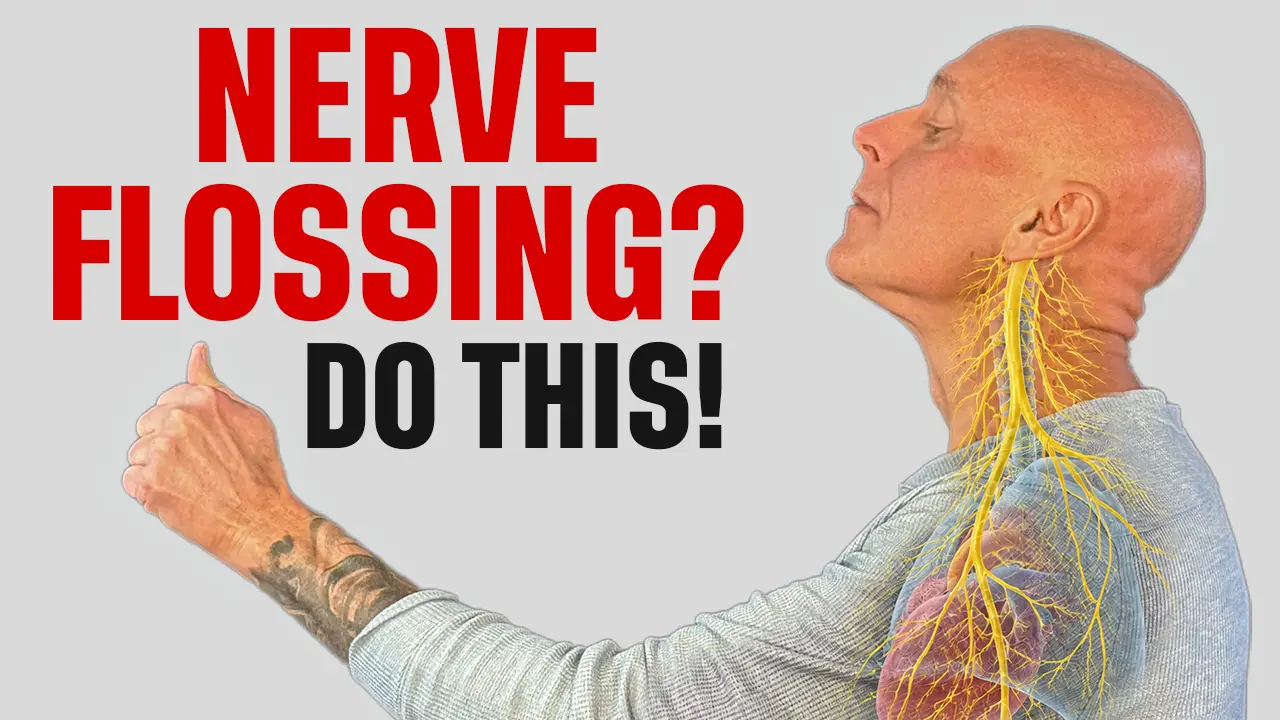
Now, having said that, let’s go through what we’re going to do about it. So let’s say I found problems with my thumb, index finger, and middle finger in flexion. First thing is a median nerve glide, or median neuromechanic exercise. You’re going to lengthen the spine. You’re going to depress your scapula. You’re going to extend your fingers, extend your wrist, lock your elbow, externally rotate, and then abduct a little bit, tilt your head away. When you do this correctly, you should feel a significant increase in nerve tension in your thumb, index finger, middle finger, and it will probably tingle a little bit. When you’re doing this, you have to keep the levels at three out of 10 or below. If you go too hard into this, you can injure yourself. So don’t do that. Once we have the tension created, what do we do? Well, we’re going to work progressively joint by joint. We’re going to take the tension off, put the tension on. Take the tension off, put it on. That gives you multiple areas where you can begin to floss the nerve through the tissue. I recommend that in each position, you do five repetitions. So five neck, five scapula, five elbow, five wrist, five finger. That’s your median nerve.
Then we go to the ulnar nerve. The ulnar nerve, again, we’re going to be in wrist extension and our, sorry, finger extension and wrist extension, but the setup for this one is different. So I’m going to be nice and tall, pull my shoulder blade down, spread my fingers, extend my wrist. Now flex my elbow really hard, like full flexion of my elbow, flex my shoulder up to about 90 degrees. And now I’m going to rotate out to the side. Now in this position, once again, I have to have my shoulder blade down, my head tilted away, and here’s the little kicker. Rotate your thumb forward. Once you’re in this position, you typically will feel, again, that same buildup of neural tension in your little finger and your ring finger. When you feel that, you know that you’re hitting the ulnar nerve correctly. And then what do we do? The same thing that we were doing before. I’m going to tension on, tension off with my neck. Tension off, tension on with my shoulder blade. I can do it with my shoulder. All right, so I’ve got everything here. I can internally rotate and externally rotate. Internal, external, internal, external. I can extend my elbow, flex my elbow. I can flex my wrist, extend my wrist. And then I can work on that hand turn. So once again, you’ve got multiple ways that you can tension on, tension off, about five repetitions at each joint involved in the chain.
Finally, we have to deal with the finger extension issues. And this one’s probably the most overlooked. People think because their hands are constantly grasping, or they forget that because our hands are constantly flexing that we also need to have excellent extensor capabilities. And in fact, when we look at the neural wiring of how our brain builds patterns of movement, we often see that hands open not only improves hand and wrist function, it’ll also improve shoulder and neck function. This is just something that most of us don’t train enough.
The way that we’re going to go after this neurologically is to go after the radial nerve. Now, the radial nerve, we’re basically gonna take the median nerve and do it exactly the opposite at the bottom. So the way that we set this one up, again, I’m nice and tall, I lengthen, I depress my scapula. Now, if you watch my hand, I’m gonna put my thumb across my palm, and I’m then going to flex my fingers and flex my wrist. And now I’m going to internally rotate from my shoulder. It’s like I’m taking a ball and I’m putting it back here, all right? Now, once I’m in this position, I have to do the same thing. Abduct my shoulder a little bit. Sometimes I need a little bit more internal rotation. And now I’m feeling that same neural sensation running across the top of my forearm all the way down into the back of my hand. So once I have that, I know that the radial nerve is being impacted. And now, what do we do? Same thing we did before. Keep it three out of 10, tension on, tension off, all the way down the chain at every joint.
This is the typical nerve, neuromechanical flow that we will teach for people that have any kind of grip issue, wrist pain, or hand pain. It is extremely important, again, that you assess correctly. You figure out which one is most affected. But in general, if you just need to throw something at someone who has a lot of these issues, do all three. Generally, what you will find is that as soon as you’re done with them, if you go back and retest sensation, you retest strength, you retest your grip, all of it will have improved, all right?
So this, for me, is one of the, I guess, most powerful little subsets of exercises that we can provide people really quickly. That’s why I wanted to put it on video for you again. So give it a shot. Hope it works really well for you. As always, if you have some chronic issues, clear these with your medical team first. And if you are a professional, you’re a doctor, therapist, coach, and in our community, we have everything from yoga, Pilates, strength coaches, sports coaches. We have a huge list of professionals and actually now a growing list even of mental health professionals that are blending neuroscience into what they do. If that’s you, you’re interested in learning more about this, we would love to talk with you, so click the link. We’d love to schedule a call and chat.