I want to show you how to work on your inner ear using a vibration tool. Now, what the heck am I talking about? First, do you know what your inner ear is? It is in neuroanatomical terms, it’s called your vestibular system. And this is a part, probably one of the most important parts of the entire nervous system for helping you live a normal, healthy, productive life.
It is our onboard balance system, if you want to think about it. It is composed basically of five sensors on each side. I always tell people, if you want to imagine it, give yourself some horns.
Those sensors, three of them are canals. And those canals are basically oriented on an XYZ axis. If you remember that from algebra in school.
And then we have what are called otolith organs. Those are called utricle and saccule. And those are involved in helping us know, are we going forward or backward or stepping to the side, or are we going up and down? And each one of them kind of has a specific task.
We have canals that are basically dedicated to telling us what our head and neck are doing as we move in space. Am I turning to the right? Am I turning left? Am I looking up? Am I on a diagonal? And on top of that, those canals are intricately connected to our eyes to help stabilize our eyes while we’re moving. So there’s a whole bunch of stuff that is going on between the eyes and the inner ear and the inner ear and the rest of the body.
Your vestibular system has a huge role to play in all of movement. What we see is if people have low-grade vestibular problems, obviously, most people think I have an inner ear issue. I’m going to have dizziness or vertigo.
Well, it’s yes, but that is this overt presentation. There’s a lot of other things that can happen from what is called subclinical vestibular dysfunction. You can go back and watch a lot of our other blogs about this.
In fact, there was some interesting studies recently that showed subclinical, meaning clients don’t even know they have the problem, but we can kind of detect it with some testing. But in subclinical vestibular dysfunction, a huge percentage of people are more prone to anxiety, which should make sense to us. Because again, if our brain’s job is to keep us alive, if it’s uncertain about how it’s going to move through the world safely, which is what our vestibular system is there to tell us, it should provoke anxiety because that is a good protective response to prevent us from doing stuff that will get us hurt.
So we have been talking about the vestibular system for two decades as a key foundational tool for all movement professionals. So if you are a doctor, a therapist, a movement professional of any kind, personal trainer, yoga, Pilates, and you are not dealing with the vestibular system because I promise you if you went through the kind of classical educational models like I did, you weren’t taught about it. You were taught about it from a very gross perspective, but not from a performance and optimization perspective.
So if this is of interest to you, go to the pinned comment and get in touch with us because you will see the vestibular system showing up through our hundreds and hundreds and hundreds of hours of our curriculum. All right, because it is that important. Often, whenever I talk about the vestibular system, I tend to give people basic exercises on social media.
Basic exercises are things like VOR drills, vestibular ocular reflex drills, where I’m standing, I pick a stance that’s kind of hard for me to maintain my balance, and then I give myself a visual target, and I do different head motions. These are canal stimulations. They are one of the most kind of classic vestibular drills available.
A lot of people have seen them, and there’s a lot of different variations on them, and we teach all of those. And they are very effective, and so it’s one of the reasons they form the core of a lot of vestibular rehabilitation. But then the question arises, what if I’m already good at these? Or what if I can’t do them without feeling terrible? Or I can’t do them without having some kind of negative effect? We have to then begin to ask the question, are there other ways to stimulate the vestibular system that may be as effective or more effective than some of the more traditional rehab approaches? So the answer is yes.
I’m going to talk about one today. What we know from a lot of testing the vestibular system, there’s some fantastic researchers out there who have been doing studies on this for 60, 70 years, but now we have some amazing meta-reviews that have come out that are getting very specific about how do we stimulate the canals? How do we stimulate the otolith organs? Can we use sound? Can we use what’s called bone-conducted sound or bone-conducted vibration? And the answer is we can use all of those things, and they affect the vestibular system differently. So specifically today, what I’m going to talk about is this $25 mini-massager from Amazon.
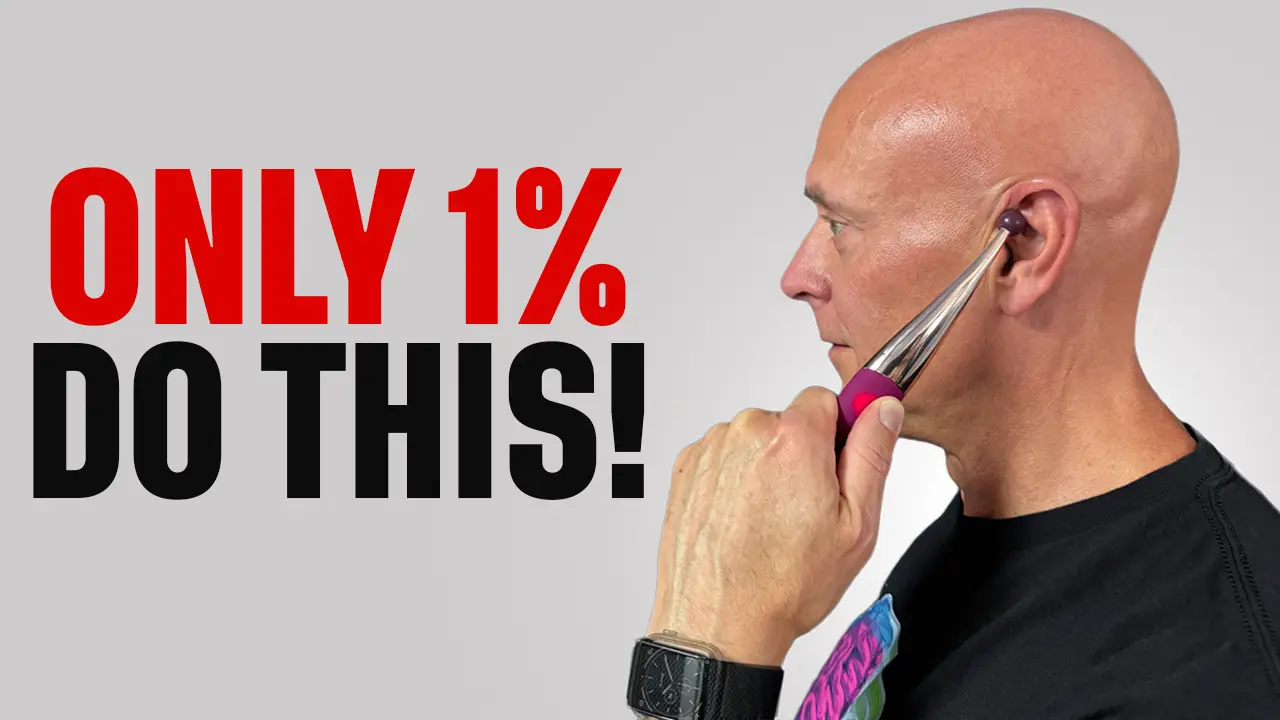
This is actually meant, there’s some tips that come with it, and you can use it on fingers and hands and jaws, in small areas of the body where a traditional handheld massager is probably too big and maybe too violent because of the amplitude. Well, one great thing about this particular device is it vibrates at around 92 to 93 hertz. What has been found is that the closer we are to 100 hertz in terms of vibration frequency, the more specifically we are able to, through bone-conducted or mastoid vibration, the mastoid’s bone right here, the more we are able to stimulate the semicircular canals.
Remember I said three canals on the XYZ axis. So basically, these are the canals that I would try to activate when I was doing a lot of my classic VOR exercises and what are called VOR cancellation exercises. So again, if I’m great at those, but I still feel like my vestibular system needs more challenge, or I can’t do them because I don’t feel well or whatever, I might find that the simple application of vibration to my mastoid process is a great prehab or a great addition.
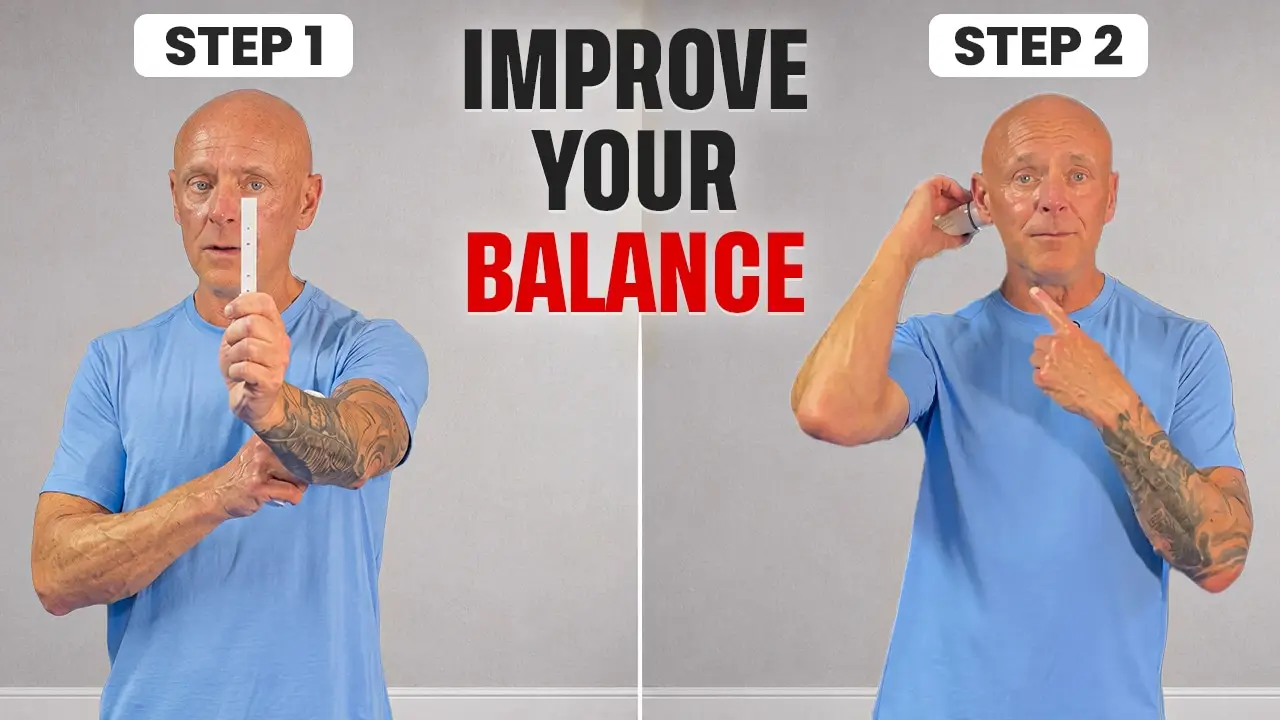
All right, so we can use it in a couple different ways. So first things first, whenever you use a device like this, you’re going to turn it on and you’re going to apply it to the mastoid process. Now you can see I actually have it basically perpendicular.
What you want to do if you’re a movement coach or professional is first you want to see how this feels. So get into a stance that for you would be a little bit challenging. If it’s feet together, if it’s on one foot and just kind of notice what your balance feels like, then turn it on and apply the vibration.
Now, because of what this does to our inner ear, very often what you’ll find is that your balance becomes more challenging, particularly if your eyes are closed and you’re requiring your vestibular system to work even harder. I use this all the time for training purposes. Let’s say I’m doing single leg balance work of some kind and it’s not that hard.
I’m not a huge believer in then going to like a unstable surface because our balance systems are very specific, meaning specific adaptation to imposed demand. So if I don’t live my life on really wobbly surfaces, it’s better that I train on a solid surface and I just make the balance activity harder. This can serve that purpose very, very well.
All right, so you can use this again to enhance any balance challenge that you’re doing simply by vibrating and what you’ll notice is that vibrating one side versus the other side is going to change because the way that your brain perceives this vibration is actually activating the canals in a given manner and that’s going to make your brain feel as if it’s moving one direction or the other when it’s actually not. So we create this little asymmetry in what the brain’s experiencing, which makes everything work a little bit harder. So that’s one of the reasons that I really love this.
But as I said, if you’re going to apply this to your clients, you need to know what it feels like. So what I often will suggest people do to begin, take a client and have them do basic VOR exercises. If you haven’t done these, go watch some of our other blogs or YouTubes.
I like to make this harder. A lot of times this is taught using a thumb or a dot on a paper. If you actually really want to make this challenging, you should give someone something very specific to read or see.
So in this particular case, I’m going to use one of these little pencils. This is called a saccade pencil and it has letters on it. The reason that I want a challenging physical target is that one of the jobs of this VOR activity is to keep the visual picture clear while my head is in motion, particularly at a faster pace.
So your job as the coach is to say, OK, I’m going to have you look at this small letter. They can look at something on their phone. It doesn’t have to be this cool pencil.
And you find out how fast they can actually do these small head rotations and small nods without the visual picture becoming blurry. You time that and you get an idea of their speed of movement, gives you an idea of how clearly and how well that reflex is working. Then you simply take the vibrating tool, the massager, mini massager.
And what I will typically tell you is if they’re doing this, you can often ask them in which direction of head movement does the picture get a little bit blurrier? So if they say, yeah, when I turn my head to the right, I have a harder time seeing it. You’re going to take the massager. You’re going to put it on the right side.
We’re going to stimulate the canals on the right side of the vestibular system with the massager for 20 to 30 seconds. And they’re not doing anything cool. They’re just standing here.
And then you remove that and then you have them go back and repeat the drill. Now, very often what you’ll find and what they will notice is that applying the vibration before doing the VOR exercise makes it easier for their vestibular system to perform the exercise correctly. So you’ve probably heard a lot about preconditioning and those approaches in strength training or plyometric training.
This is a way to kind of precondition the vestibular system to get bigger benefits from any other vestibular exercise. It is cheap. It is incredibly effective.
And there are a lot of different things that you can do with it. You can use this for, let’s say, stiff necks. You can use it to enhance extension.
The more you understand about the vestibular system, the easier it is to apply something, $24 tool to make enormous changes in session for people. I just wanted to give you this one example today of how to use a 100 Hertz or roughly 100 Hertz vibrating tool to stimulate the semicircular canals to improve someone’s overall vestibular function. Number one.
And number two, like I said, if you’re already great with all of your balance practice, you can make that harder just by adding some light vibration to it. And you can also do it on both sides, which gets even more interesting. All right.
So make sure that you pick one of these up. If you’re a moving professional of any kind, it is one of the best investments that you will ever make because it allows you to do a lot of things very quickly in session with clients that you won’t be able to achieve in any other way. So if you are a doctor, therapist or coach, moving professional, make sure to go to the pinned comment, get in touch with us.
If you find this kind of stuff interesting, because these ideas of applied neuroscience are the entire foundation of everything that we teach. We have hundreds and hundreds of hours in our curriculum that will give you literally thousands of new ways to approach common problems that you’re going to see in practice. All right.
Enjoy. Good luck.